

7 Stainless Steel Components for Large Construction Projects
Last Updated: October 26, 2026
Quick Summary
Essential stainless steel components for large scale construction are a complete 316L press-fit system of pipe, couplings, elbows, tees, valves, flanges, unions and hangers, supplied by Valtech Australia as one WaterMark certified package under WM 75254. Specifying the full set as a single system keeps sizing, profile and documentation consistent from first coupling to last flange.
- Pipe comes in 5.8-metre lengths, so runs need fewer joints and fewer presses.
- 316L lowers carbon content to improve weldability and reduce sensitisation, suiting variable water chemistry.
- Reconcile the fitting count against the pipe schedule before releasing the order.
- Stage deliveries by zone or level to match the construction sequence and avoid storage problems.
- Confirm tool calibration, square cuts and full insertion depth before pressing each joint.
Table of Contents
- Why Stainless Steel Components Suit Large-Scale Construction
- The Core Stainless Steel Press-Fit Pipe and Fittings Set
- Matching Material Grades to the Application
- Stainless Steel Pipe Sizing and System Design
- WaterMark Certified Plumbing Products and Compliance
- Building the Plumbing Materials Schedule for Construction
- Installation Quality Assurance and Commissioning Checks
- Specifying Valtech 316L Press-Fit for Your Next Project
- Frequently Asked Questions
Why Stainless Steel Components Suit Large-Scale Construction
Specifying essential stainless steel components for large scale construction comes down to one practical reality: on a major project, the pipework has to survive decades of service while being installed fast enough to keep trades moving. 316L stainless steel press-fit systems meet both demands, and Valtech Australia supplies a WaterMark certified range built around them. The material resists corrosion in aggressive water conditions and holds its strength across a long service life.
The Core Stainless Steel Press-Fit Pipe and Fittings Set
A press-fit system is only as good as its weakest joint, so the component set needs to be specified as a complete package rather than assembled piece by piece. For a deeper guide to how press-fit piping works on commercial projects, see Press-Fit Piping for Commercial Projects: A Complete Guide.
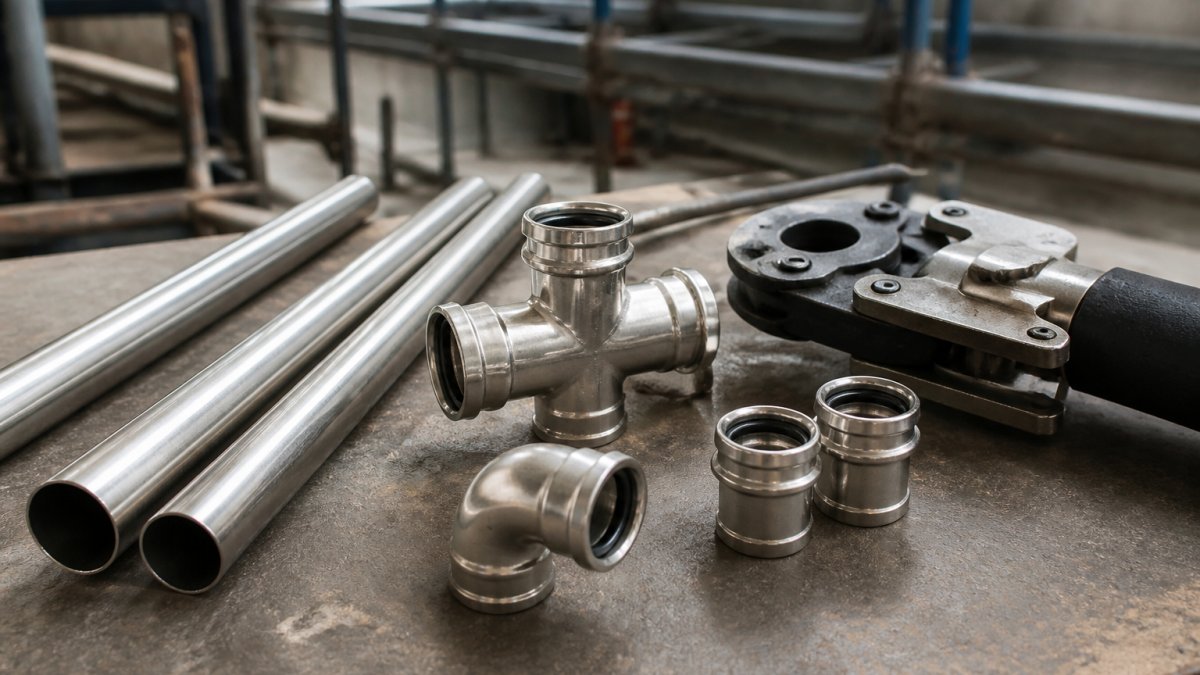
Pipe, Couplings, Elbows and Tees
The pipe is the backbone, supplied in 5.8-metre lengths so runs need fewer joints. For practical guidance on selecting the right stainless steel pipe fittings, see Choosing the Right Stainless Steel Pipe Fittings.
When mapping a system, it helps to think in terms of what each component is doing rather than just its name:
- Straight lengths carry the bulk of the run and set the joint count. Longer stock lengths mean fewer presses, fewer potential leak paths and less labour per metre.
- Couplings are the default joint between two lengths of pipe. They are the highest-volume fitting on most projects, so they dominate both the bill of materials and the press count.
- Elbows change direction. Each one adds a pressure loss, so the hydraulic designer's bend count directly affects the fittings schedule.
A common pattern on large projects is that pipe and couplings are ordered accurately because they are obvious, while tees, reducers and adaptors are under-counted because they are buried in the drawings.
Valves, Flanges, Unions and Hangers
Isolation valves, flanges and unions handle the connections to equipment and allow future maintenance without cutting pipe. Hangers and brackets carry the weight and control movement. To see which fittings commercial hydraulic projects typically need, read Which Stainless Steel Fittings Do Commercial Hydraulic Projects Need?.
Each of these deserves a line on the schedule in its own right:
- Isolation valves let a section be shut down for maintenance or fault-finding without draining the whole system. Their location is a design decision, but their quantity and size are a procurement one.
- Flanges provide a bolted connection to pumps, tanks, valves and equipment. Flange type, drilling pattern and pressure class need to be confirmed against the equipment schedule, because a mismatch is discovered on site, not in the warehouse.
- Unions allow a component to be removed and replaced without cutting pipe, useful at fixtures, meters and any item likely to be serviced.
The value of specifying the pipe and fittings as one certified system is that the profile, sizing and documentation stay consistent from the first coupling to the last flange. Mixing components from different systems introduces compatibility questions that are far easier to avoid at specification stage than to resolve during commissioning.
Matching Material Grades to the Application
Grade selection is where a lot of specifications quietly go wrong. 304 stainless steel suits many general duties, but 316 adds molybdenum for better corrosion resistance, and 316L lowers the carbon content to improve weldability and reduce sensitisation. For commercial plumbing where water chemistry varies, 316L is the safer default.
Grade choice comes down to how the three stainless options differ in corrosion resistance and weldability.
| Grade | Key difference | Best suited to |
|---|---|---|
| 304 | General-duty stainless steel | Many general duties |
| 316 | Adds molybdenum for better corrosion resistance | Duties needing more corrosion resistance |
| 316L | Lower carbon content improves weldability and reduces sensitisation | Commercial plumbing where water chemistry varies |
Stainless Steel Pipe Sizing and System Design
Sizing drives everything downstream: flow rates, pressure drop, pump selection and the fittings list. Hydraulic consultants typically size on velocity and pressure loss rather than nominal diameter alone, then match the pipe and fittings to the calculated duty. Getting this right at design stage prevents the costly rework that comes from undersized runs discovered during commissioning. A common mistake is sizing for peak demand only and ignoring future expansion.
WaterMark Certified Plumbing Products and Compliance
WaterMark certification is the scheme that demonstrates a plumbing product meets the applicable Australian requirements, and it applies to products within its scope rather than to every item on a site (What is WaterMark?). Valtech's press system is certified under WM 75254, and documentation is supplied so certifiers and inspectors can verify compliance. The WaterMark scheme administered by the ABCB sets out how the certification framework operates (Always LOOK for the WaterMark).
Building the Plumbing Materials Schedule for Construction
A plumbing materials schedule for construction is the document that turns design drawings into a procurement list, and on a large project it is where cost and programme are won or lost. Most ranking guides stop at describing the products; the project-scale work of takeoff, bill-of-materials structure, traceability and supplier qualification is where a large construction team actually spends its time.
316L Stainless Steel Pipe 108 x 2.0 x 5800 →
From Takeoff to Bill of Materials
A takeoff counts what is drawn. A bill of materials turns that count into something that can be ordered, staged and reconciled.
Build the bill of materials component by component, in a consistent order:
- Pipe by nominal size and total length, converted to stock lengths with a realistic offcut allowance.
- Fittings by type and diameter, couplings, elbows, equal and reducing tees, reducers and adaptors, each on its own line.
- Valves by type, size and end connection.
- Flanges and unions by size and drilling pattern, cross-checked against the equipment schedule.
- Supports, hangers and fixings by type and count.
- Manifolds and expansion components where the design calls for them.
A common mistake is ordering fittings against the drawing count without reconciling against the pipe schedule, which leaves shortfalls at the worst moment. The reconciliation step, does the fitting count make sense against the pipe length and the joint count?, is quick and catches most errors.
Traceability and Documentation
On large projects, the schedule is also a compliance record. Each line should be traceable back to the specification, the certified product and the batch or delivery it arrived on. In practice that means:
- Recording the product system and certification reference against each line, so a certifier can match what was installed to what was specified.
- Keeping delivery documentation and batch records with the schedule rather than in a separate folder.
- Noting any approved substitutions and the documentation that supported them.
Valtech's press system is certified under WM 75254, and documentation is supplied so certifiers and inspectors can verify compliance. Keeping that documentation aligned to the schedule from the start saves a scramble at handover.
Supplier Qualification and Lead Times
Qualifying a supplier for a large project is about more than price. The questions worth asking early are whether the supplier can hold a consistent certified system across the full component range, whether documentation is available for every line, and whether the supply can be staged to match the construction programme. Lead times should be confirmed in writing against the programme, not assumed, and the schedule should show which items are long-lead so they can be ordered first.
Staging and Bulk Purchasing
On a large site, delivering everything at once creates storage and damage problems, while delivering too late stops trades. The practical approach is to stage deliveries by zone or by level, matching the schedule to the construction sequence. Bulk purchasing of the high-volume items, pipe and couplings, can simplify logistics, but only once the takeoff has been reconciled and the fitting count is reliable.
Installation Quality Assurance and Commissioning Checks
Quality assurance starts before the first press. Confirm the tool is calibrated for the profile, that the pipe is cut square and deburred, and that the fitting is fully inserted to the marked depth before crimping. A common mistake is pressing a joint that has not been fully inserted, which passes a visual check but fails under pressure. Record each press and mark it as completed. Commissioning then follows a structured sequence:
- Verify tool calibration and press profile
- Check cut quality and deburring on every length
- Confirm insertion depth marking before each press
Specifying Valtech 316L Press-Fit for Your Next Project
Specifying Valtech 316L press-fit for your next project starts with matching the system to the duty, then confirming compliance documentation and warranty terms before the order goes out. Valtech Australia offers a 25-year product warranty, subject to the warranty terms, correct installation and appropriate application. Plumbers and contractors can access Trade Pricing for Plumbers & Contractors through a trade account registration, and Commercial Plumbing Project Quotations can be arranged for larger scopes.
Frequently Asked Questions
Which stainless steel grade is used for plumbing pipe and fittings?
304 and 316 are the two grades you will meet most often. 316L is a low-carbon version of 316, and the lower carbon content helps welded and formed components hold up in service. For commercial plumbing where water quality or chloride exposure is a concern, 316L is the usual starting point. Valtech Australia supplies 316L stainless steel press-fit pipe and fittings under the M press profile, WaterMark certified as WM 75254. Always confirm the grade suits the actual water chemistry before specifying, because no single grade suits every supply.
Is stainless steel pipe measured by internal or external diameter?
Stainless steel pipe is normally referenced by outside diameter and wall thickness, not by bore. Valtech's 108 mm pipe, for example, is 108 mm outside diameter with a 2.0 mm wall, so the internal bore is smaller than the nominal figure. This matters when you are checking flow rates against a hydraulic design, because the bore, not the outside diameter, carries the water. Read the product schedule carefully and match fittings to the same nominal size before you order.
When does a plumbing product need WaterMark certification?
WaterMark applies to plumbing and drainage products that fall within the scope of the scheme and connect to a water supply or sanitary plumbing system. Not every plumbing product requires it, so check the specific product category rather than assuming. Valtech Australia's press-fit system is WaterMark certified under WM 75254, and the certificate schedule lists the covered models. On commercial work, confirm certification before the product is specified, because substituting an uncertified item later can hold up practical completion.
How can water quality and chloride exposure affect stainless steel plumbing?
Chlorides are the main risk. At higher concentrations, and in warm or stagnant conditions, chlorides can drive pitting and stress corrosion cracking in stainless steel. That means the same grade that performs well on one site may not suit another. Have the water chemistry assessed for the project, including any dosing or disinfection regime, and follow Valtech's technical requirements on suitability. Do not assume stainless steel is immune to corrosion in every environment.
Large projects punish loose specifications, and plumbing components are no exception. Valtech Australia supplies WaterMark certified 316L stainless steel press-fit pipe and fittings with the M press profile, a 25-year product warranty and trade pricing for contractors. Get started with Valtech Australia and specify a system that holds up from first press to final handover.
