

Which Stainless Steel Fittings Do Commercial Hydraulic Projects Need?
Last Updated: October 25, 2026
Quick Summary
Commercial hydraulic projects need stainless steel fittings across six core families: couplings, elbows, tees, reducers, caps and plugs, and adaptors or threaded couplings. Specify 316L grade, match thread form, size and sealing method on every threaded connection, and confirm WaterMark certification under WM 75254 before finalising quantities.
- Build the fitting schedule around the actual pipe route, not around what a soldered system would need.
- A threaded joint must match on thread form, size and sealing method at the same time.
- BSP, NPT, JIC, ORFS and metric threads look similar but do not seal against each other.
- Mark each completed press joint, since a joint can be assembled and never crimped.
- Assess water chemistry and environment against supplier technical requirements before locking the schedule.
Table of Contents
- What Essential Stainless Steel Fittings a Commercial Hydraulic Project Actually Needs
- Stainless Steel Press-Fit Fittings: What Belongs on a Commercial Take-Off
- Hydraulic Pipe Fittings and Threaded Connections: Matching the System
- Commercial Plumbing Pipework Specification: What to Write and What to Check
- Press-Fit Plumbing Installation: Getting the Joint Right First Time
- Corrosion, Water Quality and Long-Term Service Life
- Build Your Fitting Schedule with Valtech Australia
- Frequently Asked Questions
What Essential Stainless Steel Fittings a Commercial Hydraulic Project Actually Needs
A commercial hydraulic project rarely fails because the pipe was wrong. It fails because the fitting schedule was assembled in a hurry.
This guide works through the fitting families, material grades, connection types and installation checks that decide whether a system performs for its service life or becomes a maintenance item. Below, we'll show you exactly how to build a fitting schedule that survives scrutiny from the hydraulic consultant, the certifier and the maintenance team.
The core fitting families and where each one belongs
Stainless steel fittings are the connection components that join, redirect, reduce or terminate pipe runs within a system. They fall into a small number of families, and each family does one job.
- Couplings join two lengths of pipe in a straight run.
- Elbows change direction, commonly through 90°.
- Tees create a branch from a main line.
Most take-off errors happen at the boundaries between these families, not inside them. A run that needs a branch and a size change in the same location is where schedules get thin.
Why 316L rather than a lower grade
Grade selection is the decision that sets the ceiling on service life. 316L is a low-carbon austenitic stainless steel with molybdenum in the alloy, which is why it is commonly specified where corrosion resistance matters more than upfront cost.
The honest caveat: no stainless grade is suitable for every water chemistry. Valtech publishes the material and system data for its 316L range in its 316L stainless steel press-fit technical information, which is the right document to hand a hydraulic consultant during specification review.
Stainless Steel Press-Fit Fittings: What Belongs on a Commercial Take-Off
Press-fit is the fastest-growing connection method on commercial work, and for good reason. A press-fit joint is made by inserting the pipe into a fitting containing an elastomeric seal and crimping the fitting body with a press tool, which deforms the metal onto the pipe.
For a take-off, that means the fitting schedule should be built around the actual pipe route rather than around what a soldered or welded system would need.
A practical take-off checklist:
- Walk the route and mark every direction change, branch and size transition
- Count couplings at every pipe-to-pipe joint, not just at fittings
- List every transition to an existing or alternate connection type
The Valtech range uses the M press profile and is WaterMark certified under WM 75254, with documentation supplied against the current certificate schedule. Readers who want to see the actual families available can browse the 316L stainless steel press-fit pipe and fittings range before finalising quantities.
Hydraulic Pipe Fittings and Threaded Connections: Matching the System
Threaded connections are where hydraulic and plumbing systems most often meet, and where mismatches are most expensive.
Male fittings carry an external thread; female fittings carry an internal thread.
The practical problem is that several thread forms look similar at a glance but do not seal against each other. The common families on commercial work are:
- BSP (British Standard Pipe), parallel or tapered, widely used on Australian plumbing and hydraulic equipment. BSPP is parallel; BSPT is tapered. They are not interchangeable in sealing behaviour.
- NPT (National Pipe Taper), tapered, common on imported equipment and some hydraulic components. An NPT male will often start into a BSP female, which is exactly why mismatches reach site.
- JIC (Joint Industry Council), a 37° flare connection common on hydraulic hose and tube assemblies.
A common mistake is treating thread identification as a site task. It belongs in the schedule.
Watch out: mixing thread forms that look similar but do not seal correctly produces a leak that only shows under pressure, often after the ceiling is closed. The cost of a wrong adaptor is trivial next to the cost of reopening a finished ceiling to replace it.
For transitions between a Valtech press-fit run and a threaded connection, list the thread form, size and sealing method on the schedule and confirm them against the hydraulic consultant's drawings before quantities are finalised.
Commercial Plumbing Pipework Specification: What to Write and What to Check
A commercial plumbing pipework specification is the document that tells the contractor, the certifier and the maintenance team what the system is made of and why. Vague specifications create disputes at handover.
316L Stainless Steel Equal Coupling 15 →
What a defensible specification includes:
| Item | What to state | Why it matters |
|---|---|---|
| Material grade | 316L stainless steel | Sets corrosion expectation |
| Connection method | Press-fit, M profile | Determines tooling and labour |
| Certification | WaterMark, WM 75254 | Supports compliance sign-off |
| Warranty | 25-year product warranty, subject to terms | Informs lifecycle cost |
| Application conditions | Water chemistry, environment | Justifies grade selection |
Two checks matter most. First, confirm the certification documentation matches the actual products scheduled, since WaterMark coverage is model-specific and not every plumbing product or application requires it (NCC Tutor lesson - Understanding WaterMark). Second, confirm the warranty terms and installation conditions are understood before the schedule is issued, because a warranty is only as good as the installation it covers.
Press-Fit Plumbing Installation: Getting the Joint Right First Time
The joint is the only part of a press-fit system where the installer's technique decides the outcome. Everything upstream, the grade, the certification and the schedule, is fixed by then.
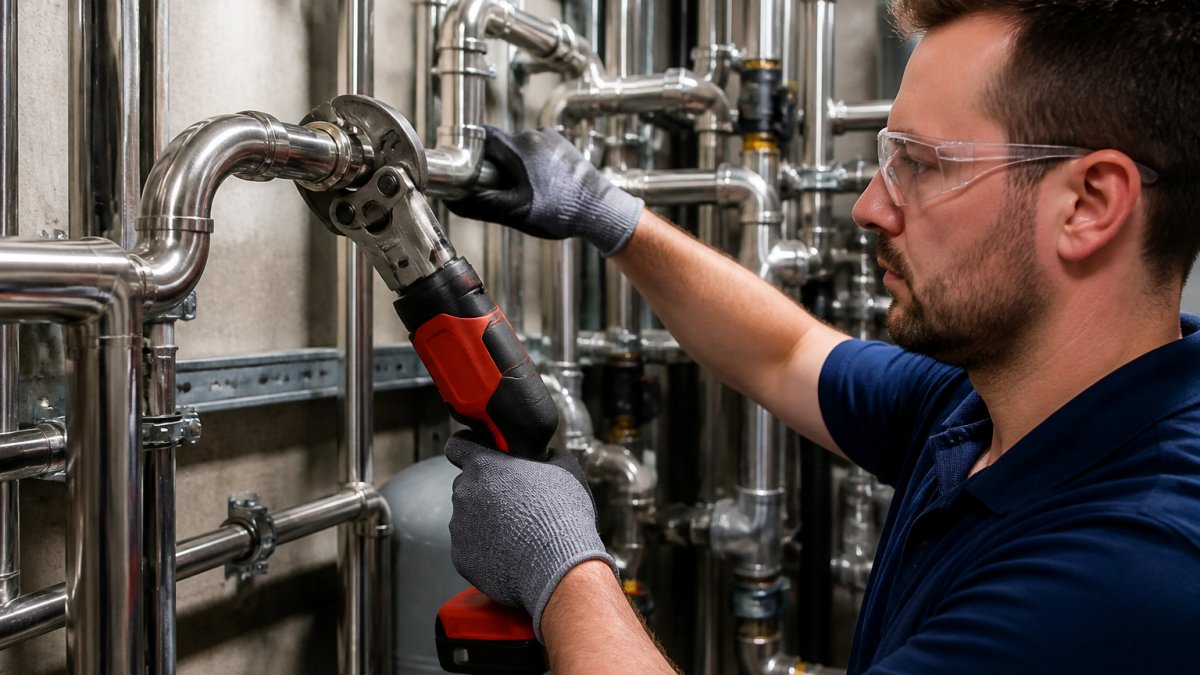
A practical installation sequence that holds up on a busy commercial site:
- Prepare the pipe end. Cut square, deburr and check for score marks or ovality. A scored pipe end or a seal with debris in it will leak regardless of press quality.
- Mark insertion depth. Use the insertion mark on the fitting or a depth gauge. A short insertion gives the seal less engagement and is one of the most common causes of weeping joints.
- Insert fully and check. The pipe should seat to the marked depth before the tool goes on.
- Match the tool to the profile. The tool jaw must match the fitting profile. Valtech's system uses the M press profile, and using the wrong jaw or an uncalibrated tool is a failure that no amount of inspection after the fact will catch.
- Press once, fully. Complete the press cycle and confirm the tool has closed fully before releasing.
- Mark each completed joint. On a busy site, a joint can be assembled and never crimped. Marking each completed joint is the simplest control against a missed press.
Four things go wrong repeatedly:
- Pipe not inserted to full depth. The insertion mark exists for a reason. A short insertion gives the seal less engagement.
- Wrong press profile. The tool jaw must match the fitting profile. Valtech's system uses the M profile.
- Missed presses. On a busy site, a joint can be assembled and never crimped. Marking each completed joint is the simplest control.
- Damaged seal or contaminated pipe end. A scored pipe end or a seal with debris in it will leak regardless of press quality.
Inspection after pressing should confirm full insertion, correct jaw marks and a completed press indicator where the fitting provides one. Where a joint is suspect, replace the fitting rather than re-pressing, because a second press on a deformed body does not restore the original seal geometry.
For a step-by-step walkthrough, Valtech's guide on how to install stainless steel press fittings covers the sequence from pipe preparation through to press completion and inspection.
Corrosion, Water Quality and Long-Term Service Life
Corrosion resistance is a system property, not a material badge. Stainless steel performs well across many conditions, but chloride exposure, stagnation, dissimilar metal contact and aggressive water chemistry all affect long-term service life.
The practical approach is to treat water quality as a design input.
A second factor is installation quality. Valtech's guidance on preventing plumbing corrosion issues sets out the practical checks that belong in a maintenance regime.
Build Your Fitting Schedule with Valtech Australia
The work that decides a commercial hydraulic project's outcome happens before the first joint is pressed. Grade selection, fitting families, connection matching, specification wording and installation discipline all compound into the system's service life.
Valtech Australia supplies 316L stainless steel press-fit pipe and fittings for commercial plumbing and hydraulic applications, using the M press profile and WaterMark certification under WM 75254, backed by a 25-year product warranty subject to the warranty terms, correct installation and appropriate application. For a schedule that needs pricing and technical confirmation, contact Valtech for pricing and technical support.
Frequently Asked Questions
What stainless steel fittings are commonly used in commercial pipework?
The common set is couplings, 90-degree elbows, equal tees, reducers, caps, plugs and threaded adaptors such as female couplings. In a press-fit system these arrive as factory-formed fittings in the M press profile, so a 15 mm equal coupling, a 90-degree equal elbow, an equal tee, a plain end reducer and a female coupling cover most of a typical plant room or riser take-off. Confirm each item against the current product schedule and certificate documentation before ordering.
How do you choose the right stainless steel fitting for a commercial project?
Work from the system specification down, not from what is on the shelf. Identify the pipe size and material first, then the connection method, then the fitting family needed to make the change in direction, branch or size reduction. Check that the fitting is WaterMark certified where the application requires it, that the press profile matches your tooling, and that the grade suits the water chemistry. Record the part code and size on the schedule so the installation matches the documented design.
What is the difference between a press-fit fitting and a threaded fitting?
A press-fit fitting is permanently joined to the pipe with a press tool, so the seal is made mechanically in one operation with no heat. A threaded fitting joins by screwing a male or female thread together, usually with a sealant or tape, and is common where a connection must be demountable or where equipment has a threaded port. Many commercial installations use both: press-fit for the main runs and threaded adaptors at plant and fixtures.
How do you check whether a press-fit system is suitable for a plumbing application?
Check three things: the certification, the application conditions and the installation requirements. Confirm the system holds WaterMark certification for the intended use, review the manufacturer's technical requirements for the water chemistry and operating conditions, and make sure the installing team has the correct tool, jaws and training for the profile. Valtech Australia supplies WaterMark documentation and installation references so specifiers can verify suitability before work starts.
What should be considered when selecting stainless steel for water quality and corrosion conditions?
Chloride and chlorine exposure is the main concern for stainless steel in water services, so the water chemistry, temperature and any dosing regime should be assessed before the grade is fixed. 316L is chosen for its molybdenum content, which improves resistance in many conditions, but no grade suits every water. Where the supply is aggressive or the environment is corrosive, have the conditions assessed and follow the manufacturer's technical requirements rather than assuming a default grade will do.
How can press-fit systems help reduce labour on commercial plumbing projects?
Press-fit removes hot work from the joint, so there is no soldering, brazing or fire watch and no cooling time before the line can be tested. A single press cycle per joint is fast, repeatable and less dependent on individual operator technique than a soldered joint. On occupied sites and in confined plant rooms, that also removes permit delays tied to hot work. The saving shows up in programme time and rework rates, not just hourly rates.
Building a fitting schedule that holds up under specification review starts with getting the material and connection details right the first time. Valtech Australia supports contractors and specifiers with 316L stainless steel press-fit pipe and fittings, WaterMark documentation under WM 75254, the M press profile system and trade pricing for registered accounts. Get started with Valtech Australia and build a schedule that stands up to scrutiny.
