

Press-Fit Piping for Commercial Projects: A Complete Guide
Table of Contents
- What Press-Fit Piping Is and Why It Matters for Commercial Work
- Materials and Pipe Selection for Commercial Applications
- Commercial Plumbing Project Planning with Press-Fit Systems
- Step-by-Step Press-Fit Plumbing Installation Process
- Press-Fit System Commissioning Checklist for Commercial Projects
- Press-Fit System Commissioning Checklist for Commercial Projects
- Press-Fit Pipe Maintenance and Long-Term Performance
- Advantages and Practical Considerations for Commercial Contractors
- Frequently Asked Questions
Last Updated: October 16, 2026
What Press-Fit Piping Is and Why It Matters for Commercial Work
Press fit piping for commercial projects uses a mechanical connection instead of soldering, swaging or threading: a press tool compresses a fitting onto prepared pipe, creating a permanent, leak-free seal without heat or hot work.
For commercial contractors, this changes timelines, labour costs and site safety. Installations that once required hot work permits and fire watch protocols can proceed without them, and press-fit joints take seconds versus minutes for soldering, efficiency that compounds across hundreds of joints.
How press-fit joints differ from traditional methods
A soldered joint requires heating, applying solder and cooling. A threaded connection demands cutting, threading and torquing. A swaged joint needs specialised tools and precise technique.
A press-fit joint works differently. The fitting contains an internal O-ring or sealing element. When the press tool applies force, it deforms the pipe slightly, compressing it against the O-ring to create a mechanical interlock that holds pressure without adhesive, solder or thread compound.
The practical difference shows up immediately on site:
- No open flame or heat source needed
- No cooling time between joints
- No threading waste or rework
- Lower skill variation between operators
- Faster system commissioning
Why commercial projects benefit from press-fit systems
Commercial projects operate under constraints residential work rarely faces. A shopping centre renovation cannot shut down water supply for extended periods. A hospital cannot risk solder fumes in occupied spaces.
Press-fit systems address these constraints directly: installation speed reduces downtime, mechanical connections eliminate hot work and its permits, and consistent joints lower rework and pressure test failures.
Pressing a joint also requires less training than soldering, so a team can move through a large installation faster with fewer skilled tradespeople per site.
Materials and Pipe Selection for Commercial Applications
Pipe material selection shapes the project lifecycle, determining corrosion resistance, cost and compatibility with water chemistry and service conditions.
316L stainless steel versus copper and carbon steel
Copper has dominated commercial plumbing for decades and is compatible with most water conditions, but its corrosion resistance depends on water chemistry.
316L stainless steel resists corrosion in chloride-rich environments, aggressive water chemistries and mixed-metal scenarios where copper would fail, and does not require painting or coating.
The trade-off is upfront cost: stainless steel pipe costs more per metre than copper.
Valtech Australia supplies 316L stainless steel press-fit pipe and fittings, certified under WaterMark WM 75254.

Assessing water chemistry and corrosion resistance
Before specifying pipe material, assess water chemistry and service conditions. Chloride content, pH, dissolved oxygen and temperature all affect corrosion risk.
The practical approach: consult water quality data for the project location. If chloride levels are high, pH is low or water chemistry is uncertain, specify stainless steel.
Valtech Australia's technical team can advise on material selection based on site conditions, and application conditions should be assessed against Valtech's technical requirements.
Commercial Plumbing Project Planning with Press-Fit Systems
Commercial projects require specification and planning before a single pipe is cut. Press fit piping for commercial projects introduces new considerations: tool requirements, fitting availability, and installer training.
System design and fitting selection
A commercial press-fit system begins with a schematic: pipe runs, flow rates, pressure zones, and service points. From this, the designer selects pipe diameter and fitting types.
Press-fit fittings come in standard configurations: couplings, elbows, tees, and reducers. Unlike soldered systems, press-fit doesn't allow custom bends or field fabrication.

Valtech Australia's 316L stainless steel range includes equal couplings, 90° elbows, equal tees and other standard fittings, with the M press profile ensuring compatibility across the range.
Specification, procurement, and tool requirements
Specifying a press-fit system requires naming the press profile, in Valtech's case, the M profile, and confirming WaterMark certification.
Procurement must account for lead times. Commercial projects often have tight schedules, so confirm availability and timeframes with the supplier before finalising the project timeline.
For contractors new to press-fit, tool investment is a consideration. Renting tools for a project is an option, while purchasing makes sense for regular users.
Step-by-Step Press-Fit Plumbing Installation Process
The installation process is straightforward but requires attention to detail. Each step affects joint integrity.
Pipe preparation and cutting
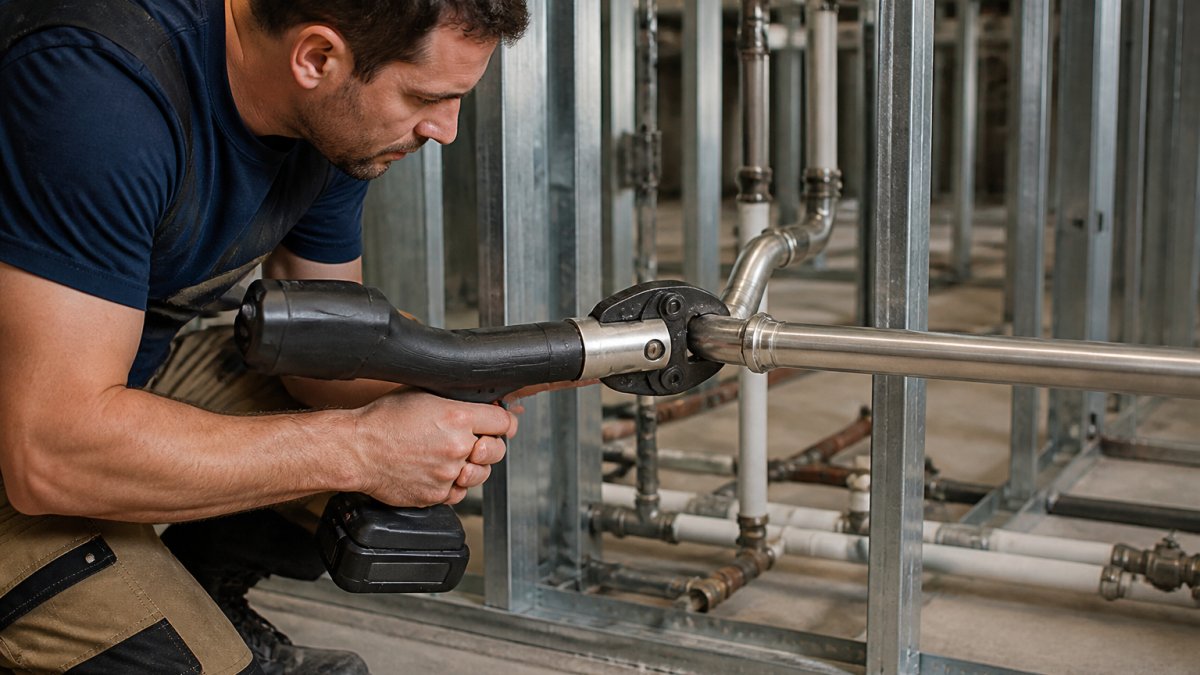
Press-fit installation starts with pipe preparation. The pipe must be cut square, to length, and deburred.
Cutting: use a pipe cutter or hacksaw.
Length: measure twice. Press-fit fittings have a defined insertion depth, too short and the pipe won't insert fully, too long and it won't fit inside the fitting.
Deburring: remove burrs from the inside and outside of the pipe.
Cleanliness: wipe the pipe end clean with a dry cloth. Dirt or debris inside the pipe can compromise the seal.
Pressing the joint and verifying integrity
Once the pipe is prepared, insert it into the fitting to the marked insertion depth.
Position the press tool jaws around the fitting so they contact the fitting's press points, usually marked dimples or grooves.
Activate the press tool.
Remove the tool. Inspect the joint. A properly pressed fitting shows a visible compression mark or deformation where the jaws contacted the fitting.
Verify insertion depth by checking that the pipe reaches the stop inside the fitting, which some fittings mark with a visible line or shoulder.
Common installation mistakes to avoid
Incomplete insertion: The most common error is inserting the pipe too shallowly. The O-ring seal requires full contact.
Dirty pipe: Dirt, dust, or moisture inside the pipe can prevent the O-ring from sealing. Always clean the pipe end before insertion.
316L Stainless Steel Pipe 15 x 1.0 x 5800 →
Damaged fittings: a dented or scratched fitting may not seal properly. Inspect fittings before use and discard any that are damaged.
Wrong tool: using a press tool with a different profile will not compress the fitting correctly. Always confirm tool compatibility before starting.
Press-Fit System Commissioning Checklist for Commercial Projects
Before the system is handed over, it must be tested, inspected, and documented.
Pre-commissioning inspection and pressure testing
Before pressurising, inspect all joints visually for:
- Proper compression marks on all fittings
- Consistent pressing across all joints
- No visible cracks or damage to pipe or fittings
- Correct insertion depth confirmed on sample joints
Once visual inspection is complete, perform a pressure test. Fill the system slowly with water, venting air as it fills, then pressurise to the design pressure or the test pressure specified in the project documents.
Hold pressure for the duration specified, typically 10 to 30 minutes for a commercial system, and monitor the gauge. If pressure drops, identify and re-press the leaking joint, then retest.
After pressure testing, flush the system to remove debris and verify water quality at all outlets.
Documentation and handover requirements
Document all commissioning activities:
- Date and time of pressure test
- Test pressure and duration
- Gauge readings at start and end
- Any joints re-pressed and retested
- Final pressure test result (pass/fail)
- System flushed (yes/no) and water quality checked
Retain this documentation for the building owner as evidence that the system was installed and tested correctly.
For WaterMark certified systems, retain copies of the WaterMark certificate and installation documentation. These support compliance claims and assist with future maintenance or modifications.
Provide the building owner with a system schematic showing pipe routes, shut-off valves, and isolation points. Include maintenance guidance: routine inspection intervals, warning signs of corrosion or leaks, and contact information for service.
Press-Fit System Commissioning Checklist for Commercial Projects
A practical commissioning checklist ensures nothing is missed:
| Task | Responsibility | Status |
|---|---|---|
| Visual inspection of all joints | Site supervisor | ☐ |
| Pressure test to design pressure | Licensed tester | ☐ |
| Hold pressure for specified duration | Licensed tester | ☐ |
| Monitor and record gauge readings | Licensed tester | ☐ |
| Identify and re-press any leaking joints | Installer | ☐ |
| Retest after repairs | Licensed tester | ☐ |
| System flush and water quality check | Installer | ☐ |
| Document all test results | Site supervisor | ☐ |
| Obtain WaterMark documentation | Procurement | ☐ |
| Provide schematic and handover docs to owner | Site supervisor | ☐ |
Press-Fit Pipe Maintenance and Long-Term Performance
After commissioning, the system requires minimal maintenance. Stainless steel resists corrosion, and mechanical joints don't degrade like solder bonds.
Routine inspection and monitoring
Annual visual inspection is good practice. Check for:
- Visible corrosion or discolouration on pipe or fittings
- Leaks at any joint
- Loose or missing insulation (if pipes are insulated)
- Damage from physical contact or vibration
If corrosion is visible, assess the extent. Light surface discolouration is normal for stainless steel in some environments and does not indicate failure. Pitting or deep corrosion requires investigation. If corrosion is progressing, the water chemistry or service conditions may be unsuitable for the material. Consult Valtech Australia's technical team.
Leaks at joints are rare in properly installed press-fit systems. If one appears, it usually indicates an incomplete initial installation or damage to the fitting. The joint can be re-pressed if the fitting is undamaged; if damaged, it must be replaced.
Troubleshooting and addressing failure modes
Slow leak at a joint: this suggests incomplete compression.
Corrosion on pipe or fitting: Assess the extent. Light surface oxidation is cosmetic.
Vibration or noise in the system: press-fit joints are rigid and don't absorb vibration like flexible connections.
Low pressure or reduced flow: This usually indicates a blockage, not a joint failure. Flush the system or isolate the affected section to identify the source.
Leaks at isolation valves or connection points: these are not press-fit joint failures but issues with the valve or connection.
Advantages and Practical Considerations for Commercial Contractors
Press-fit systems offer clear advantages for commercial work, along with practical considerations.
Speed, labour efficiency, and project economics
A press-fit joint takes 10 to 20 seconds from insertion to pressing, while a soldered joint takes 2 to 5 minutes including heating, soldering and cooling.
This speed translates to labour cost savings. Fewer labour hours per installation means lower total project cost.
Labour consistency is another advantage.
For commercial projects where downtime is costly, occupied buildings, retail spaces, hospitals, the speed advantage is worth more than the material cost difference.
WaterMark compliance and regulatory approval
In Australia, potable water systems must comply with WaterMark requirements.
Valtech Australia's 316L stainless steel press-fit system is WaterMark certified under WM 75254.
WaterMark certification is a prerequisite for approval by building inspectors and water authorities. Without certification, the system cannot be used in potable water applications.
When specifying a press-fit system, always confirm WaterMark certification. Request the certificate and check the applicable product schedule. Valtech Australia provides WaterMark documentation with all products.
For non-potable applications, industrial systems, solar hot water, or closed-loop systems, WaterMark may not be required.
Press-fit piping for commercial projects eliminates hot work constraints, reduces labour time, and provides consistent, reliable joints. Register for Trade Pricing for Plumbers & Contractors to access technical support and streamlined procurement.
Frequently Asked Questions
What is press-fit piping and how does it work in commercial buildings?
Press-fit piping uses a mechanical O-ring seal and pressing force to join pipe and fittings without soldering or hot work. A battery-powered or manual press tool applies calibrated pressure to compress the fitting onto the pipe, creating a permanent leak-free connection. In commercial buildings, this method eliminates confined-space hot-work restrictions, speeds installation, and reduces labour requirements compared to traditional soldering.
Why should a commercial contractor switch from copper to 316L stainless steel press-fit piping?
316L stainless steel offers superior corrosion resistance in aggressive water chemistries and high-chloride environments, a 25-year product warranty (subject to the warranty terms, correct installation and appropriate application), and WaterMark certification under WM 75254. Whilst stainless steel press-fit systems cost more upfront than copper, the durability advantage, reduced maintenance, and longer service life offset the initial investment on large commercial projects.
What should be included in a press-fit system commissioning checklist before handover?
Before handover, conduct a full pressure test at the design pressure, inspect all joints visually for defects, verify insertion depths on a sample of fittings, flush the system to remove debris, and document results. Provide the building owner with product warranties, maintenance guidance, and contact details for future support. Ensure the system is clean and ready for service.
How often should press-fit piping be inspected and maintained in a commercial building?
Inspect press-fit pipework annually for visible corrosion, leaks, or mechanical damage. Monitor water quality and pH if local supply conditions are corrosive. Check for scale or sediment buildup in areas with hard water. Keep detailed maintenance records. Most press-fit systems require minimal intervention if installed correctly and the water chemistry is suitable, but regular visual inspection catches problems early.