

WaterMark Certified Stainless Steel Pipe Suppliers
Table of Contents
- What WaterMark Certification Actually Covers for Stainless Steel Pipe
- WaterMark Product Certification Lookup: How to Verify a Licence and Scope
- 304 vs 316L Stainless Steel Pipe: Which Grade Suits Your Project
- 316L Stainless Steel Press-Fit Pipe and Fittings: What to Expect From a Certified System
- Stainless Steel Pipe Supplier Checklist for Trade Buyers
- Comparing WaterMark Certified Stainless Steel Pipe Suppliers
- Conclusion
- Frequently Asked Questions
Last Updated: October 9, 2026
What WaterMark Certification Actually Covers for Stainless Steel Pipe
WaterMark certification is a mandatory product certification scheme that applies to many plumbing and drainage products supplied in Australia, and it is the first thing a specifier should check when sourcing pipe. For stainless steel pipe, that means the pipe and its fittings have been assessed against the standard that governs the system, not just the metal itself.
Here is where most buyers get it wrong: they treat a WaterMark number as a blanket approval for anything the supplier sells. It is not. Certification attaches to specific product models listed on a certificate schedule, and the scope of that schedule is what matters.
This guide from Valtech Australia covers how to read a certificate, verify a licence, compare grades, and build a stainless steel pipe suppliers checklist that stands up to scrutiny on a commercial project.
When WaterMark Applies and When It Does Not
Not every plumbing product requires WaterMark. The scheme applies to products that fall within its scope, typically those connected to the supply of drinking water or to plumbing and drainage installations covered by the Plumbing Code of Australia.
That distinction matters when a supplier claims "WaterMark certified" as a marketing line. Ask which products on their list are certified and under what certificate. If the answer is vague, treat the claim as unverified.
WaterMark Product Certification Lookup: How to Verify a Licence and Scope
A WaterMark product certification lookup is the process of checking a certificate number against the official register to confirm the licence is current and the product in front of you sits within its scope.
Start with the certificate number the supplier provides. Confirm the licence holder, the certificate status, and the expiry date. Then read the product schedule line by line and match it against the exact model, size, and material you are buying.
Reading a Certificate Schedule Properly
The schedule is the controlling document. It names the models covered, and anything not named is outside the certification. A typical schedule entry identifies the product category, the model or product code, the size range, the material, and the standard the product was assessed against.
A common pattern in procurement is to accept the certificate number at face value and never open the schedule. That is where compliance gaps are born. The number existing is not the same as the number covering your product.
Certified Fitting vs Certified Pipe System
One of the more useful distinctions, and one most supplier pages skip, is the difference between a certified fitting and a certified pipe system. A certificate can attach to a fitting, to a length of pipe, or to a system where pipe and fittings are assessed together as a matched assembly.
If the certificate covers the fitting only, the pipe it is pressed onto may sit under a separate certificate or under a different scope entirely. If the certificate covers the system, the pipe and fittings are assessed as a matched pair and should be supplied and installed together.
Matching the Certificate Schedule to the Product You Receive
When goods arrive, compare the marking on the pipe or fitting against the schedule entry. Check the material grade, the dimensions, and any model or product code. The marking on the product and the entry on the schedule should agree.
Where a supplier can supply WaterMark documentation on request, ask for it up front. Valtech Australia supplies WaterMark documentation for its 316L stainless steel press system under certificate WM 75254, and buyers should confirm the applicable model in the current certificate schedule before ordering.
A Short Verification Sequence
- Obtain the certificate number from the supplier in writing.
- Check the licence holder, status, and expiry date on the official register.
- Open the schedule and confirm the product category matches what you are buying.
- Match the model, size, and material on the schedule to the product marking.
- Confirm whether the certificate covers the fitting, the pipe, or the system.
- File the schedule with the project documentation before installation.
Done once at order stage, this sequence takes minutes. Done after practical completion, when pipe is behind a wall, it becomes a much harder conversation.
304 vs 316L Stainless Steel Pipe: Which Grade Suits Your Project
The choice between 304 and 316L stainless steel pipe comes down to the service environment, not the price list.
Grade 304 is the general-purpose option and suits many benign water and process applications.
Neither grade is a universal answer. Water chemistry, chloride concentration, temperature, and the surrounding environment all affect how a stainless system performs over its service life.
| Grade | Typical Positioning | Key Consideration |
|---|---|---|
| 304 / 304L | General-purpose stainless | Chloride exposure is the limiting factor |
| 316 / 316L | Higher chloride resistance | Confirm water chemistry and environment |
Other grades such as 304H appear in high-temperature service, but those are specialised selections outside most plumbing and commercial work.
316L Stainless Steel Press-Fit Pipe and Fittings: What to Expect From a Certified System
A 316L stainless steel press-fit pipe and fittings system joins pipe and fittings mechanically using a press tool rather than heat.
316L Stainless Steel Pipe 15 x 1.0 x 5800 →
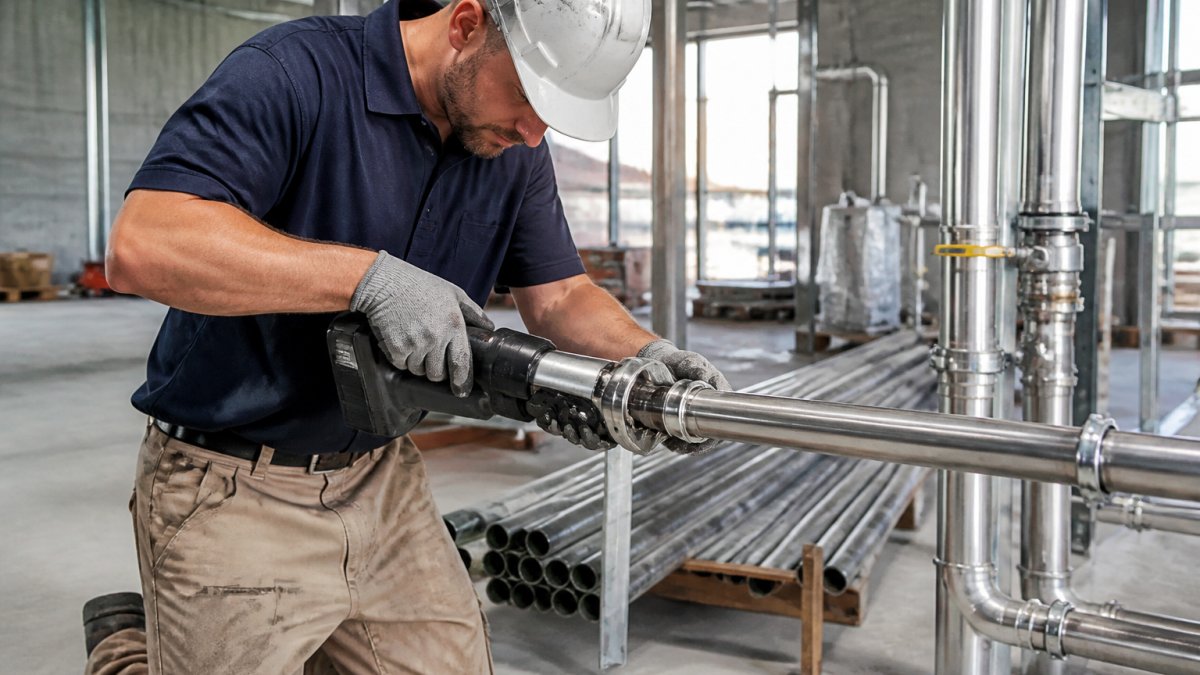
The practical upside is speed and reduced hot works. On confined or occupied sites where hot works permits are difficult to obtain, press-fit removes a scheduling bottleneck.
Valtech Australia supplies a 316L stainless steel press system using the M press profile. The range includes pipe in a 5.8-metre length across a spread of outside diameters, from 15 mm through to 108 mm, with wall thicknesses varying by size.

Sizes, Wall Thickness and the M Press Profile
Size selection follows the design flow and pressure requirements of the project, not convenience. The Valtech pipe range runs from 15 x 1.0 x 5800 at the small end up to 108 x 2.0 x 5800, with intermediate sizes including 22 x 1.2, 28 x 1.2, 35 x 1.5, 42 x 1.5, 54 x 1.5, and 76.1 x 2.0.
The M press profile is the contour the press tool forms on the fitting. Profile compatibility matters: the tool, the fitting, and the pipe must belong to the same system. Confirm the profile before any tool purchase.
Stainless Steel Pipe Supplier Checklist for Trade Buyers
A stainless steel pipe supplier checklist is a short set of questions that separates a compliant supplier from a confident one. Run it before you commit to a purchase order.
- Is the product covered by a current WaterMark certificate, and does the schedule list the exact model and size?
- Can the supplier provide the certificate schedule and installation documentation on request?
- Is the grade appropriate for the water chemistry and environment on this project?
- Are pipe and fittings supplied as a matched system with a stated press profile?
- Is sizing available across the full range the project needs, or only part of it?
- Are trade pricing and account terms available for repeat buyers?
- Is there a stated product warranty, and what does it actually cover?
Traceability and Compliance Documentation
Traceability is what allows a product to be tied back to its certification at handover. Keep the certificate schedule, the product marking, and the installation documentation together as a package. If a question arises during inspection or at practical completion, that package answers it.
Documentation should be requested at order stage. Chasing a certificate schedule weeks after installation, when the pipe is buried behind a wall, is a far harder conversation.
Comparing WaterMark Certified Stainless Steel Pipe Suppliers
Comparing suppliers on certification alone misses the point. Two suppliers can both hold valid certification and still differ on range depth, documentation support, sizing, and commercial terms. The comparison should be built around what the project actually needs.
| Criteria | What to Check | Why It Matters |
|---|---|---|
| Certification scope | Current WaterMark certificate and schedule | Confirms the exact product is covered |
| Grade range | 304, 304L, 316, 316L availability | Matches material to service conditions |
| Size coverage | Full diameter and wall thickness range | Avoids split sourcing across suppliers |
| System match | Pipe and fittings from one system | Profile and seal compatibility |
| Documentation | Certificate schedule and install docs | Supports inspection and handover |
| Commercial terms | Trade pricing and account setup | Affects repeat-purchase cost |
The range covers pipe from 15 mm to 108 mm in 5.8-metre lengths, the system uses the M press profile, and it holds WaterMark certification under WM 75254. Trade pricing is available through a registered trade account, and commercial project quotations can be requested for larger scopes.
What to Ask Before You Place an Order
Ask for the current certificate schedule and confirm your exact model appears on it. Ask whether pipe and fittings are supplied as one matched system. Ask what documentation accompanies the delivery. Ask how trade pricing is structured and whether a trade account is required.
Get the answers in writing. A supplier that answers these questions quickly and clearly is usually a supplier that has done it before.
Conclusion
Sourcing compliant stainless steel pipe comes down to verification: check the certificate, match the schedule to the product, and confirm the grade suits the service conditions. Buyers who skip that step inherit the risk at handover.
Valtech Australia supplies 316L stainless steel press-fit pipe and fittings under WaterMark certificate WM 75254, using the M press profile, with pipe available from 15 mm to 108 mm in 5.8-metre lengths.
Get started with Valtech Australia and specify a certified press-fit system with the documentation to back it.
Frequently Asked Questions
What does WaterMark certification mean for stainless steel pipe?
WaterMark certification means a product has been assessed against the relevant Australian technical specification and is listed on a certificate schedule with a defined scope. For stainless steel pipe, that scope sets out which product models, sizes and grades the certificate covers. It is not a blanket statement about every item a supplier sells, so always match the certificate schedule to the exact product and size you are ordering. Valtech Australia's press system is WaterMark certified under WM 75254, and documentation is supplied so you can confirm the applicable model.
How can I check whether a stainless steel pipe product is WaterMark certified?
Ask the supplier for the certificate number and the current schedule, then confirm the product model, size and grade appear in that schedule. A WaterMark product certification lookup should return the licence holder, the certificate status and the scope of products covered. If the schedule does not list the size you need, the certification does not extend to it. Keep a copy of the schedule with your project compliance file so it can be produced at inspection or handover.
Does WaterMark certification apply to every plumbing product?
No. WaterMark applies to products covered by the relevant Australian technical specifications, and not every plumbing item falls within that scope. Some components are covered by other conformity routes or by the manufacturer's own quality documentation. Rather than assuming every item on an order needs WaterMark, check each product against its applicable specification. If you are unsure whether a particular fitting or pipe falls in scope, confirm with the supplier and record the answer.
What should I check before choosing a stainless steel pipe supplier?
Work through a stainless steel pipe supplier checklist: current WaterMark certificate and schedule, product range and size coverage, grade availability including 304 and 316L, fittings and connectors to match the pipe, traceability and compliance documentation, trade pricing terms, and delivery arrangements for your site. Also confirm technical support is available for application questions. A supplier who can produce documentation quickly and answer specification queries saves time at inspection and handover.
What is the difference between 304 and 316L stainless steel pipe?
Both are austenitic stainless steels, but 316L contains molybdenum, which generally gives it better resistance to chlorides and more aggressive environments than 304. That makes 316L a common choice where water chemistry or the surrounding environment is a concern. Grade selection should follow the project specification and an assessment of the actual application conditions. Stainless steel is not suitable for every water chemistry, so confirm suitability against Valtech's technical requirements before ordering.