

Stainless Steel Pipe for Fire Services: 2026 Guide
Table of Contents
- Why Stainless Steel Pipe for Fire Services Is Specified More Often
- Comparing Pipe Options for Fire Sprinkler System Piping Standards
- 304 vs 316L: Which Grade Belongs in a Fire Water Supply
- Corrosion Prevention in Fire Service Pipes: MIC, Chlorides and Stagnation
- 316L Stainless Steel Press-Fit Fittings and the M Profile System
- Stainless Steel Pipe Installation Best Practices for Press-Fit and Grooved Joints
- Cost, Compliance and Retrofitting: The 20-Year View
- Frequently Asked Questions
Last Updated: October 2, 2026
Why Stainless Steel Pipe for Fire Services Is Specified More Often
Specifiers increasingly choose stainless steel pipe for fire services because it removes the internal corrosion that shortens the working life of carbon steel fire water supply lines. The shift is practical rather than fashionable: a fire sprinkler system sits idle for years, then must perform on demand, and internal corrosion is the main reason that reliability erodes over time.
What Changes When You Move Away From Carbon Steel
Carbon steel fire mains depend on a protective lining or coating to survive. Where that lining is damaged, or where water sits stagnant for long periods, corrosion begins from the inside, and the pipe wall thins where nobody can see it.
Comparing Pipe Options for Fire Sprinkler System Piping Standards
Three families dominate fire sprinkler system piping: black or galvanised carbon steel, copper, and stainless steel. Each meets the mechanical demands of a fire water supply differently, and the trade-offs sit in corrosion behaviour, joint method, and whole-of-life cost rather than in headline price.

| Option | Corrosion behaviour | Joint method | Best suited to |
|---|---|---|---|
| Carbon steel | Relies on lining or coating | Grooved, threaded, welded | Dry, well-maintained systems |
| Copper | Good, but costlier in large bores | Press, soldered | Smaller-bore branch lines |
| Stainless steel | Passive oxide layer re-forms | Press-fit, grooved | Wet systems, stagnant or aggressive water |
Where Each Option Earns Its Place
Carbon steel remains the default for many dry systems because the pipe is not normally full of water. Its weakness is that the protective lining or coating is the only thing standing between the steel and corrosion, and that lining can be damaged during installation, cutting, or grooving. Once compromised, corrosion starts from the inside and the wall thins where it cannot be seen.
Joint Method Changes the Site Risk
The joint method is not just a technical detail, it changes what happens on site. Welded and threaded carbon steel joints introduce hot works, fire watches, and the need to isolate detection systems during installation. Grooved and press-fit joints remove hot works from the programme entirely, which is the practical difference on occupied sites such as shopping centres, hospitals, and operating data centres.
304 vs 316L: Which Grade Belongs in a Fire Water Supply
The choice between 304 stainless steel and 316 stainless steel comes down to molybdenum. Grade 316 contains it, and that addition improves resistance to chlorides and to the pitting that chlorides drive.

Corrosion Prevention in Fire Service Pipes: MIC, Chlorides and Stagnation
Corrosion prevention in fire service pipes rests on three fronts: microbiologically influenced corrosion, chlorides, and stagnation. All three attack carbon steel, and all three are amplified by the fact that fire mains sit full of still water for most of their lives.
316L Stainless Steel Press-Fit Fittings and the M Profile System
Valtech Australia's 316L stainless steel press-fit range uses the M press profile and is WaterMark certified under certificate WM 75254, with documentation supplied by Valtech Australia. WaterMark certification applies to products within its scope, and the applicable model should be confirmed against the current certificate schedule for the project at hand.
Stainless Steel Pipe Installation Best Practices for Press-Fit and Grooved Joints
Stainless steel pipe installation best practices start with joint preparation, not with the tool. Press-fit and roll grooved joints both rely on the pipe end being clean, square and undamaged, and most failures trace back to a step skipped before the tool came out.
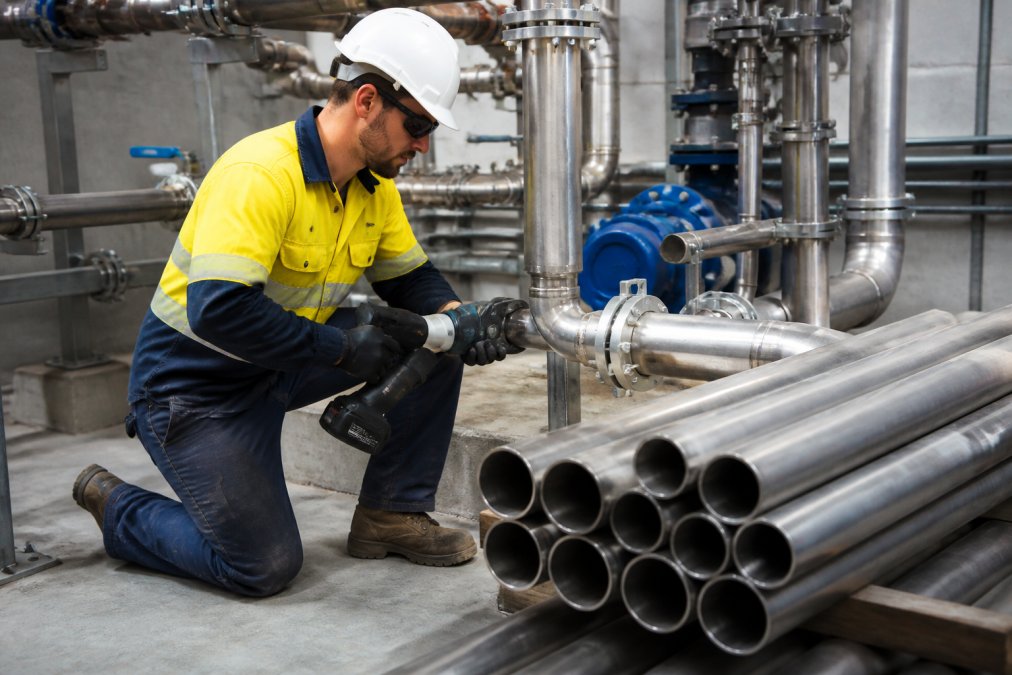
For press-fit work:
- Cut square and deburr the pipe end fully
- Mark the insertion depth so the fitting seats correctly
- Keep the seal clean and free of grit or swarf
- Complete the press cycle fully and verify the jaw alignment
Cost, Compliance and Retrofitting: The 20-Year View
The 20-year view changes the comparison. Stainless steel costs more at the point of purchase, but the case rests on what is avoided later: internal corrosion, unplanned shutdowns, and the replacement of a main that has thinned from the inside. This is the section most guides skip, because a like-for-like capital cost comparison is easier to write than a whole-of-life one.
316L Stainless Steel Pipe 15 x 1.0 x →
A Total Cost of Ownership Framework
A defensible TCO comparison for fire service piping should account for:
- Initial material and installation cost, stainless steel carries a higher material price, but press-fit joints reduce labour hours compared with welded or threaded alternatives.
- Corrosion allowance and wall thickness, carbon steel is often specified with a corrosion allowance, which adds material weight and cost that a like-for-like comparison can miss.
- Inspection and condition assessment, internal corrosion in carbon steel is invisible from outside, so condition assessment needs to look inside the pipe. That work has a cost, and it recurs.
- Unplanned shutdown and remediation, a thinned main that fails or is condemned mid-life forces replacement in a live building, which is the most expensive way to do the work.
- Replacement cycle, a longer service life defers the next capital spend, which is where the 20-year view diverges most sharply from the 5-year view.
Compliance and Certification
Compliance sits alongside cost. WaterMark certification applies to plumbing and drainage products within its scope, and confirming certification and the current certificate schedule is part of specifying correctly. Not every plumbing product or application requires WaterMark, so the applicable scope should be checked against the current certificate schedule for the project at hand.
Environmental Impact and Sustainability
On environmental impact, stainless steel is fully recyclable and its long service life defers replacement, which reduces material throughput over a building's life. That argument strengthens as the assessment period lengthens, and it aligns with the ESG reporting that many commercial developers and facility managers now carry. The comparison is not simply stainless versus carbon steel by weight, it is the number of times a main must be replaced over the building's life, and the embodied carbon that each replacement carries.
Retrofitting Into Occupied Buildings
A practical retrofit sequence that most guides omit:
- Survey the existing system, confirm pipe routes, bore sizes, and any concealed runs before design.
- Isolate and drain in stages, staged isolation keeps the majority of the fire system live during the works.
- Cut and prepare pipe ends, square cuts and full deburring are non-negotiable for press-fit joints.
- Press and verify, complete the press cycle fully and verify jaw alignment before moving on.
- Pressure test and document, test the new section and record the results for the building's compliance file.
Valtech Australia supplies 316L stainless steel press-fit pipe and fittings with WaterMark certification under WM 75254, the M press profile, and a 25-year product warranty subject to the warranty terms, correct installation and appropriate application. For contractors and specifiers weighing a switch, register for trade pricing and have the water chemistry and application conditions assessed against Valtech's technical requirements before the specification is locked in.
Frequently Asked Questions
Is stainless steel pipe suitable for fire sprinkler systems?
Yes, stainless steel pipe is used in fire sprinkler and fire water supply systems, particularly where corrosion resistance matters. Grade 316L offers better resistance to chlorides and microbial corrosion than 304, which suits many commercial and industrial settings. Suitability still depends on the water chemistry and environment at the site, so application conditions should be assessed and the supplier's technical requirements followed before specifying.
Does fire service piping require WaterMark certification?
Not every plumbing product or application requires WaterMark, but products covered by a WaterMark Level of Accreditation must hold certification to be legally supplied for those uses. Valtech Australia's 316L stainless steel press system is WaterMark certified under WM 75254, with documentation supplied by Valtech. Confirm the applicable model in the current certificate schedule before you order.
What are the benefits of using 316L stainless steel in fire services?
Grade 316L resists chlorides and microbial corrosion better than 304, which matters in stagnant or intermittently flowing fire water supply lines. It also holds its own in high-temperature fire conditions and maintains pipe integrity where carbon steel would corrode over time. Press-fit joints reduce hot works on site, and Valtech Australia backs its range with a 25-year product warranty, subject to warranty terms, correct installation and appropriate application.
What are the disadvantages of using stainless steel pipes?
Stainless steel costs more upfront than carbon steel, and the press tool investment is a real barrier for smaller operations doing mostly residential work. It is not suitable for every water chemistry, since high chlorine or chloride exposure can affect some grades, so conditions need assessing. Cutting and handling also require care to avoid contamination that undermines corrosion resistance.
How does stainless steel perform in high-temperature fire conditions?
Stainless steel retains strength at elevated temperatures better than many alternatives, which helps a fire water supply stay intact long enough to do its job. The exact performance depends on the grade, wall thickness and system design rather than a single blanket figure. For a specific project, work from the manufacturer's technical data and the fire engineering requirements rather than assuming a universal temperature rating.
What are the maintenance requirements for stainless steel fire service lines?
Maintenance is lighter than for carbon steel because there is no routine repainting or internal corrosion treatment. Inspections should still follow the relevant fire system maintenance schedule, checking for mechanical damage, support integrity and any signs of external corrosion at pipe penetrations. Keeping water moving and avoiding long stagnant periods helps limit MIC risk in any fire water supply.