

Press Fit Tools for Plumbers: A 2026 Guide
Table of Contents
- Why Press Fit Tools Matter for Modern Plumbing
- Understanding Press Tool Jaws for Plumbers
- M Profile Press Tool Compatibility Essentials
- Powered Press Tools for Plumbing Applications
- Press Tool Maintenance and Servicing
- Choosing the Right Press Fit Tool for Your Operation
- Frequently Asked Questions
Last Updated: October 17, 2026
Why Press Fit Tools Matter for Modern Plumbing
Press fit technology has transformed how Australian plumbers approach water supply installations, with press fit tools for plumbers in Australia now essential for modern commercial work.
For plumbers and contractors managing commercial installations, the choice of press fit system affects everything from job scheduling to long-term maintenance costs.
Valtech Australia supplies premium 316L stainless steel press-fit pipe and fittings designed specifically for the Australian market.
Understanding the fundamentals of press tool selection, jaw compatibility, pipe materials, and system standards, helps contractors make informed decisions that improve efficiency and reduce rework on site.
Understanding Press Tool Jaws for Plumbers
Press tool jaws are the replaceable components that grip and compress the fitting onto the pipe.
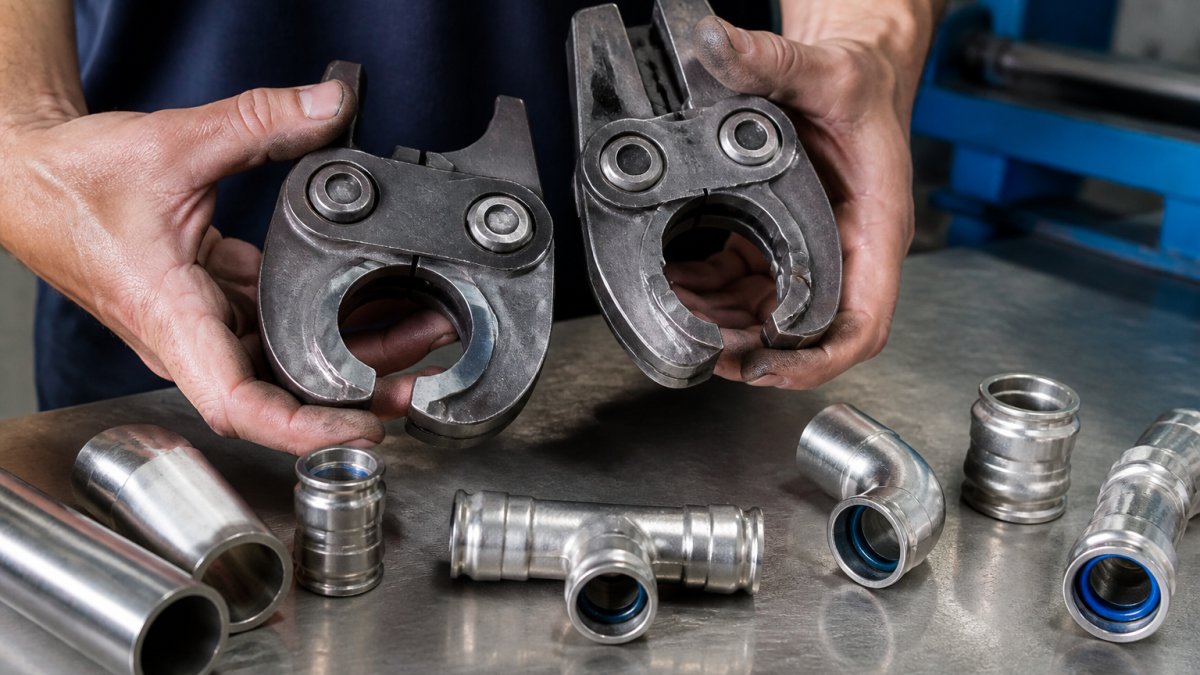
The most common jaw profiles in Australia are U-profile and M-profile (also called KP-profile). Each profile is engineered to compress a specific fitting design.
When selecting a press tool, the first decision is which jaw profile your project requires. This choice often depends on the fitting system already specified or available from your supplier.
Verifying a Complete Compatible System Before You Buy
Most buying mistakes happen at the seams between four separate items: the tool, the jaw, the fitting and the pipe. A tool that presses M-profile fittings correctly in copper may not be the right choice for stainless steel, and a jaw that fits one tool brand may not physically mount on another. Before committing to a purchase or a hire, work through the chain in this order.
- Confirm the fitting profile. Read the fitting system's documentation or packaging and identify whether it is M-profile or U-profile. Do not infer the profile from the fitting's appearance, confirm it from the supplier's technical literature.
- Confirm the jaw profile matches. The jaw must be the same profile as the fitting. An M-profile jaw is only correct for M-profile fittings.
- Confirm the jaw mounts to your tool. Jaw mounting interfaces differ between tool platforms. Check the tool manufacturer's jaw compatibility list for the specific jaw model, not just the profile name.
- Confirm the jaw and tool are rated for the pipe material. Copper, stainless steel, multilayer and PEX each behave differently under compression. Check that the jaw and tool combination is listed by the tool manufacturer as suitable for the material you are pressing.
- Confirm the size range covers every diameter on the job. A tool that stops at 25 mm will not help on a project that steps up to 32 mm, and a compact tool may not cover the full range.
- Confirm the fitting system's own installation requirements. The fitting supplier's installation instructions govern how the joint must be pressed, follow them rather than assuming a generic procedure.
For a Valtech Australia 316L stainless steel press-fit installation, the fitting system uses the M press profile and is WaterMark certified under WM 75254. That tells you the profile to match; it does not remove the need to confirm that your specific tool and jaw are listed by the tool manufacturer as suitable for stainless steel in the sizes you are pressing. Where the tool documentation is unclear, confirm with the tool supplier before pressing.
Jaw Profiles and Fitting Compatibility
M-profile jaws are designed to work with M-profile press fittings. These fittings have a distinctive pressing range and are widely used in commercial plumbing across Australia.
Compatibility is non-negotiable. A press tool with M-profile jaws cannot properly compress a U-profile fitting, and attempting to do so risks damaging the fitting or creating a weak connection that will leak under pressure.
Before purchasing or renting a press tool, confirm which profile your fittings use. Check the fitting manufacturer's documentation or the product packaging.
Pipe Materials and Size Ranges
Press fit tools work with multiple pipe materials: copper, PEX, PEX-AL-PEX, stainless steel, and multilayer pipe. Each material has different compression characteristics, and not every tool handles every material equally well.
Stainless steel pipe, for instance, requires consistent, controlled compression. The material is harder than copper, and uneven jaw pressure can result in incomplete fitting seals or surface damage.
Pipe size ranges vary by tool.
When selecting a press tool, match both the material your pipe is made from and the diameter range you'll be working with.
M Profile Press Tool Compatibility Essentials
The M press profile is the standard for modern commercial plumbing installations in Australia. Valtech Australia's WaterMark certified system (WM 75254) uses the M profile, which means any M-profile press tool will work with Valtech fittings.
Compatibility across M-profile systems is straightforward: an M-profile jaw from one manufacturer will compress an M-profile fitting from another, provided both are designed to the same standard.
However, interchangeability does not mean all M-profile tools perform identically. Tool quality, pressure consistency, and durability vary.
Matching Tools to Fitting Systems
Before purchasing or renting a press tool, identify the fitting system your project requires. If you're working with Valtech Australia's 316L stainless steel press-fit range, you'll need an M-profile press tool.
Some contractors maintain a library of tools to handle different profiles or materials. Others rent specialised tools for specific projects. The decision depends on project frequency, available capital, and storage space on site.
When renting a tool, verify that it's calibrated and in good working order. A poorly maintained tool can produce inconsistent compression, leading to weak fittings or damage to the fitting body.
WaterMark Certification and Standards
WaterMark certification is a requirement for most plumbing products used in water supply systems in Australia.
Valtech Australia's stainless steel press-fit system is WaterMark certified under WM 75254, which means it meets the standards required for water supply installations. When specifying or purchasing press-fit fittings for commercial projects, always confirm WaterMark certification status.
Press fit tools themselves are not WaterMark certified, the certification applies to the fittings and pipe. However, using an approved tool correctly ensures that the installation meets the standard the fitting was certified to.
Powered Press Tools for Plumbing Applications
Manual press tools require significant hand force to compress the fitting, which can be tiring during long installations and may lead to inconsistent pressure if the operator fatigues. Powered (battery-operated) press tools eliminate this issue by applying consistent, controlled force automatically.
Battery-Powered vs Manual Options
Manual press tools are lightweight, portable, and require no charging or maintenance. They're suitable for small jobs, occasional use, or situations where portability is critical. However, they demand physical effort and can be slower on large-scale projects.
Battery-powered press tools deliver consistent pressure with minimal user effort. They're faster for high-volume installations and reduce operator fatigue. The trade-off is weight, charging requirements, and tool cost.
Some contractors use both: manual tools for occasional work or remote sites where charging isn't practical, and battery-powered tools for standard commercial installations. The choice depends on your typical workload and project demands.
Ergonomics and Job Suitability
Job suitability extends beyond just profile compatibility. Consider the physical environment where the tool will be used. In confined spaces, such as plant rooms or under-floor installations, a compact or mini press tool may be necessary.
Tool weight matters on extended installations. A heavy tool becomes fatiguing when used repeatedly throughout the day. Ergonomic design, grip comfort, balance, and control, directly affects work quality and crew satisfaction.
For commercial projects involving hundreds of fittings, a battery-powered tool is typically the most cost-effective choice when you factor in time savings and reduced rework from operator error.
Press Tool Maintenance and Servicing
A well-maintained press tool will deliver consistent results for years. Poor maintenance leads to uneven jaw wear, inconsistent compression, and ultimately, weak or damaged fittings.
Calibration and Inspection Schedules
Press tools should be inspected regularly for jaw wear, alignment, and pressure consistency. Worn jaws will not compress fittings evenly, creating weak spots in the seal.
If a tool has been dropped, heavily used, or hasn't been serviced in several years, have it professionally inspected before using it on critical installations. A service technician can assess jaw condition, verify pressure output, and recalibrate if needed.
For contractors using tools daily, an annual service is a reasonable preventive measure. For occasional users, inspection before each major project is sufficient.
Choosing the Right Press Fit Tool for Your Operation
The right tool depends on three factors: the fitting profile your projects require, the volume of work you do, and your budget.
Cost Considerations Beyond the Initial Purchase
Tool cost is only the first expense. Consider maintenance, repairs, jaw replacements, and battery costs (if applicable). A cheaper manual tool that requires frequent repair or jaw replacement may cost more over time than a higher-quality tool that lasts years with minimal servicing.
Renting is an option for occasional projects or when testing a new system before committing to purchase. Rental costs are typically higher per use but eliminate storage and maintenance responsibilities.
For contractors doing regular commercial work, ownership usually makes financial sense. For those handling only occasional press-fit projects, renting may be more practical.
Common Mistakes to Avoid
Using the wrong jaw profile for your fittings is the most common error and results in failed connections or damaged fittings. Always confirm jaw profile before work begins.
Failing to maintain the tool leads to inconsistent compression and weak fittings. A damaged or worn tool should be serviced before returning to site.
Attempting to use a manual tool on high-volume installations is inefficient and increases operator fatigue, which can lead to mistakes.
Overlooking WaterMark certification when specifying fittings for water supply projects can result in non-compliant installations that fail inspection. Always verify certification status before purchase.
Selecting the right press fit tool for plumbing applications requires understanding jaw compatibility, fitting systems, and your project demands. For Australian plumbers and contractors working with modern commercial installations, the M-profile press fit system has become standard. Valtech Australia's WaterMark certified 316L stainless steel press-fit range uses the M profile, offering a durable, corrosion-resistant option for water supply projects where long-term reliability matters. For Commercial Plumbing Project Quotations and Trade Pricing for Plumbers & Contractors, register with Valtech Australia for competitive rates and Australia-wide delivery.
Frequently Asked Questions
What press tool do plumbers use for WaterMark certified press-fit systems?
Plumbers use press tools designed specifically for the fitting profile of their chosen system. For M profile press-fit systems like Valtech Australia's WaterMark certified range (WM 75254), the tool must have compatible jaws that match the fitting geometry. The tool applies uniform pressure to crimp the fitting onto the pipe, creating a permanent seal without soldering or threading. Always verify that your press tool's jaw profile matches your fitting system before purchase.
How do I know if a press tool is compatible with my press-fit fittings?
Compatibility depends on three factors: the jaw profile (U-profile, KP-profile, or M profile), the pipe material (copper, stainless steel, PEX, or multilayer), and the pipe diameter range. Check your fitting manufacturer's documentation to identify the correct profile, then confirm your press tool has jaws rated for that profile and your pipe size. For 316L stainless steel press-fit systems, ensure the tool is specified for stainless steel applications and the jaw size covers your pipe diameter range (typically 16-32 mm for most commercial applications).
What is the difference between a powered press tool and a manual press tool?
Manual press tools require physical force from the operator to crimp each fitting, making them suitable for small-scale or occasional work. Powered press tools, including battery-powered and cordless options, apply pressure automatically, reducing operator fatigue and increasing consistency on high-volume jobs. Battery-powered tools offer mobility and speed on site, while corded electric tools provide continuous power but require access to an outlet. Choose based on your job frequency, site conditions, and crew size.
Do press tools need different jaws for different pipe sizes?
Yes. Press tools use interchangeable jaws sized for specific pipe diameters. A single tool body typically accommodates multiple jaw sets covering a range (for example, 16-32 mm). You must purchase jaw sets for each diameter you work with regularly. Jaw compatibility is profile-specific, so U-profile jaws cannot be used with KP-profile or M profile fittings. When investing in a press tool system, calculate the jaw sets you'll need based on your typical project specifications and budget accordingly.