

Press-Fit Plumbing Reliability for High Pressure
Table of Contents
- Is Press-Fit Plumbing Reliable for High Pressure?
- How Press-Fit Connections Create a Watertight Seal
- Understanding Press-Fit Plumbing Pressure Ratings
- M Profile Press Fittings and System Compatibility
- Installation Quality and Common Press-Fit Fitting Installation Errors
- Pressure Testing and Verification for High-Pressure Systems
- Press-Fit vs. Traditional Methods for High-Pressure Applications
- WaterMark Certification and Compliance
- Frequently Asked Questions
Last Updated: October 11, 2026
Is Press-Fit Plumbing Reliable for High Pressure?
Press-fit plumbing high pressure systems create a permanent mechanical seal by compressing a sealing ring against the pipe and fitting body. For Australian plumbers and contractors, understanding whether press-fit delivers the reliability needed for high-pressure systems is essential before specifying it on critical projects.
Valtech Australia's 316L stainless steel press-fit range, certified under WaterMark WM 75254 and using the M press profile, addresses the demands of high-pressure water supply and heating applications. The key question is how to ensure installation quality, verify pressure compatibility, and recognise where press-fit excels versus where alternatives may be preferable.

How Press-Fit Connections Create a Watertight Seal
A press-fit connection works through mechanical compression. When a specialist press tool forces the fitting onto prepared pipe, an internal sealing element compresses between the fitting body and the pipe surface, creating a watertight and airtight seal that remains permanent.
Three critical elements are required: proper pipe preparation, correct fitting insertion, and appropriate tool pressure. The pipe end must be cut square, deburred, and cleaned of debris or oxidation. The press tool's jaws apply uniform pressure around the fitting circumference, forcing the sealing element into place and creating a joint that resists internal pressure and external leakage.
Once formed, a press-fit joint does not rely on adhesive, solder, or thread sealant. The mechanical compression is permanent and will not degrade from vibration, thermal cycling, or pressure fluctuation as soldered joints can crack or threaded connections can loosen. This permanence makes press-fit connections highly reliable for high-pressure applications when installed correctly.
Understanding Press-Fit Plumbing Pressure Ratings
Pressure ratings vary by fitting type, pipe size, and profile standard. The M press profile used by Valtech Australia has defined pressure capabilities that differ from other standards. Ratings are expressed as working pressure (maximum safe operating pressure) and test pressure (pressure at which the joint is verified during commissioning).
For M profile systems, smaller pipe sizes (15 mm to 22 mm) generally support higher working pressures than larger sizes, because smaller cross-sectional areas experience lower total force. Different press profiles (such as TH or V) have entirely different pressure ratings.
Pressure ratings depend on pipe and fitting material. Stainless steel press fittings, like those in Valtech Australia's range, tolerate high pressures because stainless steel resists deformation under sustained load. Copper press fittings have lower pressure ratings due to copper's material properties.
Always verify that the system's pressure rating exceeds your design pressure with appropriate safety margin. Consult the manufacturer's technical documentation or WaterMark certification schedule to confirm the pressure rating for your exact pipe size and fitting type.
M Profile Press Fittings and System Compatibility
The M press profile is defined by specific jaw dimensions, compression depth, and sealing element geometry. Fittings and tools designed for the M profile are not interchangeable with other profiles; attempting to use an M profile tool on a TH or V profile fitting will result in improper compression and joint failure.
Valtech Australia's 316L stainless steel press-fit system uses the M profile exclusively. All Valtech fittings work with M profile press tools. If switching from another supplier to Valtech, verify that existing tools are M profile compatible before ordering fittings.
The M profile standard defines sealing element material and compression characteristics. Mixing profiles introduces risk and should never occur on a job site.
For high-pressure applications, system consistency matters. Using the same press profile, fittings, tools, and installation technique throughout a project reduces variables and simplifies pressure testing. Switching profiles mid-project complicates commissioning and creates opportunities for installer error.
Installation Quality and Common Press-Fit Fitting Installation Errors
Installation quality is the single biggest factor determining whether a press-fit system will be reliable under high pressure. Common installation errors fall into several categories.
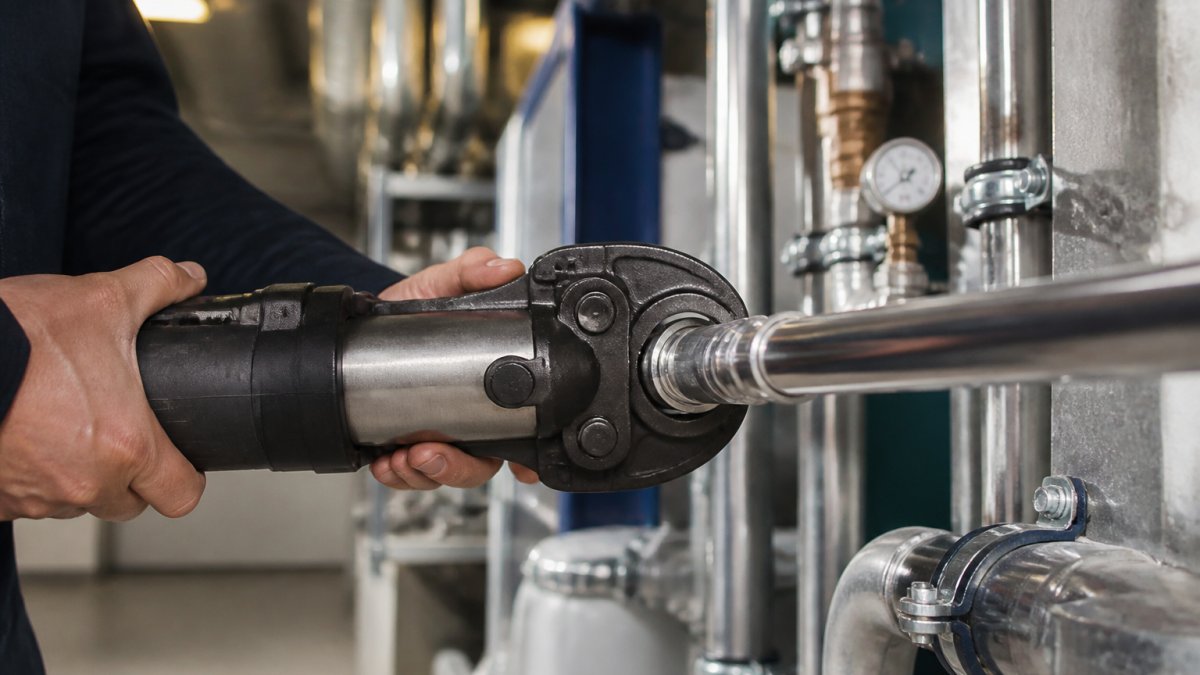
Improper pipe preparation is the most frequent cause of failed press-fit joints. Pipe ends must be cut square using a pipe cutter and deburred to remove sharp edges. Oxidation, scale, or dirt on the pipe surface prevents the sealing element from compressing evenly, leaving gaps where water can escape.
Worn or damaged press tool jaws prevent full compression. Over time, jaws wear and reduce their contact surface, making it difficult to achieve uniform pressure. A worn tool may appear to compress the fitting, but the sealing element may not be compressed enough to form a watertight seal.
Incorrect fitting insertion occurs when the fitting is not pushed fully onto the pipe before pressing. If the pipe does not extend far enough into the fitting, the sealing element may not compress properly. If the pipe extends too far, it may contact internal components and prevent sealing.
Operator technique varies widely. Uneven or rapid pressure application can damage the sealing element or cause the fitting to slip. Training and experience matter; experienced plumbers install joints more reliably.
Using the wrong fitting size for the pipe is an error that should never occur. A 22 mm fitting will not compress properly onto 15 mm pipe.
Pressure Testing and Verification for High-Pressure Systems
After installation, pressure testing is the only way to verify that all joints are sound. A pressure test involves filling the system with water and pressurising it to a test pressure, typically 1.5 times the design pressure, and holding it for a specified duration while monitoring for leaks or pressure drop.
For high-pressure systems, pressure testing is a commissioning requirement mandated by Australian plumbing standards and building codes. It confirms that the system can hold pressure and reveals installation errors before the system is put into service.
A press-fit system that passes pressure testing has a high probability of remaining reliable in service. Joints that leak during testing must be repaired or replaced before commissioning.
316L Stainless Steel Pipe 15 x 1.0 x 5800 →
Pressure testing confirms that a joint is watertight at the test pressure but does not guarantee performance under dynamic conditions such as rapid pressure cycling, water hammer, or thermal stress. Proper installation technique remains critical even for systems that pass pressure testing.
For high-pressure applications, consider pressure testing at the design pressure to add confidence that the system will perform reliably throughout its service life.
Press-Fit vs. Traditional Methods for High-Pressure Applications
Press-fit plumbing, soldering, and threaded connections each have strengths and limitations for high-pressure applications. Understanding the trade-offs helps specify the right method for each project.
| Method | Seal Type | Pressure Capability | Installation Time | Skill Required | Reliability |
|---|---|---|---|---|---|
| Press-Fit (M Profile) | Mechanical compression | High (system-dependent) | 2-4 minutes per joint | Moderate | High if installed correctly |
| Soldering (Copper) | Solder bond | Moderate to high | 5-10 minutes per joint | High | High if executed well |
| Threaded (Brass/Steel) | Thread sealant + compression | Moderate | 3-5 minutes per joint | Low | Moderate; prone to loosening |
Press-fit advantages for high pressure: No open flame required (important in confined spaces or hot-works-restricted areas). Faster installation than soldering once trained. Permanent seal that does not degrade from vibration or thermal cycling. Highly repeatable, reducing variability between joints.
Press-fit limitations: Requires specialist tools and training. Operator error during installation can compromise the seal. Pressure ratings vary by system and fitting size.
Soldering advantages: Flexible, can join pipes of different materials. Well-established technique familiar to many experienced plumbers. Pressure ratings are well understood.
Soldering limitations: Requires open flame, restricted in confined spaces or under hot-works procedures. Joint quality depends heavily on operator skill. Thermal stress can anneal copper pipe. Joints can crack under pressure cycling or vibration.
Threaded limitations: Thread sealant can degrade over time. Joints can loosen under vibration or thermal cycling. Pressure ratings are generally lower than press-fit or soldering.
For high-pressure applications in confined spaces or areas where hot works are restricted, press-fit plumbing high pressure solutions are often the preferred choice. For applications requiring flexibility in joining different materials, soldering remains the standard.
WaterMark Certification and Compliance
In Australia, plumbing products used in water supply systems must comply with AS/NZS 3500 and carry WaterMark certification. WaterMark certifies that a product meets the applicable Australian Standards for safety, performance, and durability.
Valtech Australia's 316L stainless steel press-fit system is WaterMark certified under certificate WM 75254. The certification applies to the specific pipe sizes, fitting types, and pressure ratings documented in the certificate schedule.
WaterMark certification is not a blanket approval for all applications. The certificate specifies which pipe sizes, fitting materials, and pressure ratings are approved. Using a WaterMark-certified product outside its documented scope, for example, applying a fitting rated for 1000 kPa to a 1200 kPa system, voids the certification and creates compliance risk.
For commercial projects, building inspectors and hydraulic consultants will verify that all plumbing products carry appropriate WaterMark certification. Specifying uncertified products or using certified products outside their approved scope will result in the work being rejected and requiring remediation.
When specifying press-fit systems for high-pressure applications, always confirm that the system is WaterMark certified and that the pressure rating in the certificate exceeds your design pressure. If you are uncertain whether a particular application falls within the certified scope, contact the manufacturer or consult the WaterMark certificate schedule directly.
The 25-year product warranty offered by Valtech Australia is subject to the warranty terms, correct installation, and appropriate application. Proper specification and installation are essential to maintaining warranty coverage.
Press-fit plumbing is reliable for high-pressure applications when four conditions are met: the system is properly specified for the design pressure, the pipe is meticulously prepared, the installation is performed by trained operators using compliant tools, and the completed system is pressure tested before commissioning.
For plumbers and contractors seeking a certified, high-pressure press-fit solution, Valtech Australia's 316L stainless steel press-fit pipe and fittings provide a reliable alternative to soldering and threading. For commercial plumbing projects, Valtech Australia offers trade pricing for plumbers and contractors and support for commercial plumbing project quotations to help you specify the right system for your next high-pressure installation.
Frequently Asked Questions
How much pressure can a press-fit plumbing system handle?
Pressure capacity depends on the fitting system, pipe size, and profile design. The M profile press-fit system used by Valtech Australia is engineered to handle high-pressure applications in commercial plumbing and heating systems. Specific pressure ratings vary by fitting type and size. Always consult the manufacturer's technical documentation and system certification (such as WaterMark certification under WM 75254) to confirm the working pressure for your application.
What are common press-fit fitting installation errors that cause failures?
Installation errors that compromise reliability include inadequate pipe preparation (dirt, debris, or damage on the sealing surface), incomplete pipe insertion into the fitting, misaligned or crooked insertion, and using incorrect or damaged press tools. Proper training, clean work practices, and verification that the press tool creates an audible or visible confirmation mark are essential. Inspect each joint after pressing to ensure the fitting is seated correctly and the sealing element is engaged.
Is press-fit plumbing suitable for commercial high-pressure applications?
Yes, when specified correctly and installed by trained personnel. Press-fit systems offer reliability, speed of installation, and permanent connections suitable for commercial plumbing and heating systems. WaterMark certified systems like Valtech Australia's 316L stainless steel press-fit range (WM 75254) meet Australian standards for commercial applications. Confirm that the system is rated for your specific pressure, temperature, and water chemistry conditions before specifying.
How is a press-fit plumbing system pressure-tested?
Pressure testing is performed after installation to verify the integrity of all joints. The system is filled with water and pressurised to the test pressure specified in the design or standard. Each visible joint is inspected for leaks under pressure. The test pressure is typically higher than the working pressure. Documentation of the test results, including the pressure held and duration, should be retained as part of the commissioning record. Follow the system manufacturer's guidance and relevant Australian Standards for test procedures.