

Is Press Fit Plumbing Safe Long-Term? What to Know
Table of Contents
- Is Press Fit Plumbing Safe Long-Term?
- Press-Fit Fittings Lifespan: What to Expect
- Press-Fit Fittings Failure Causes and Warning Signs
- Press-Fit Plumbing Installation Best Practices
- Press-Fit Plumbing Maintenance and Inspection
- Concealed Pipework: Managing Risk Where You Can't See the Joint
- Pros and Cons of Press-Fit Plumbing
- Conclusion
- Frequently Asked Questions
Last Updated: October 21, 2026
Is Press Fit Plumbing Safe Long-Term?
Press fit plumbing is safe long-term when the system is certified, correctly installed and suited to the water conditions on site. A press-fit joint is a mechanical connection formed by crimping a metal fitting onto pipe with a press tool, compressing a sealing element inside the fitting to create a permanent joint without solder or flame.
Whether press fit plumbing is safe long-term comes down to three things: fitting quality, installer discipline, and whether the application suits the material. Valtech Australia supplies WaterMark certified 316L stainless steel press-fit pipe and fittings.
Press-Fit vs Push-Fit: Different Systems, Different Risk
Press-fit and push-fit are not the same product, and treating them as interchangeable is a common and expensive mistake.
- Press-fit fittings are permanently crimped with a tool. The joint cannot be pulled apart by hand once pressed.
- Push-fit fittings rely on an O-ring and a grab ring, and the pipe simply pushes in. Some are demountable.
- Press-fit suits permanent, concealed pipework where the joint is never revisited.
The risk profiles differ. A push-fit joint depends on the O-ring staying seated and the pipe staying fully inserted; a press-fit joint depends on the correct tool, profile and a properly prepared pipe end. Both can fail, but for different reasons.
Press-Fit Fittings Lifespan: What to Expect
There is no single lifespan figure that applies to every press-fit fitting, but understanding where commonly quoted figures come from, and which variables move the real-world outcome, helps.
Where the Numbers Come From
When you see a press-fit system described as lasting 20, 25 or 50 years, that figure usually traces back to one of three sources:
- A product warranty, a contractual commitment by the supplier, valid only while the stated conditions (correct installation, appropriate application, sometimes registration and maintenance) are met.
- Accelerated or type-testing data, laboratory testing that simulates long-term pressure and temperature exposure, extrapolated to a service-life estimate under defined conditions.
- Industry convention, a nominal design life used across plumbing materials for specification purposes, not a guarantee that a specific joint in a specific building will reach that age.
These are not the same thing. A warranty is a promise with conditions attached; a test result is evidence under controlled conditions; a design-life convention is a planning assumption. Treating any of them as a guarantee of every joint is where expectations go wrong.
Valtech Australia backs its 316L stainless steel press-fit range with a 25-year product warranty, subject to the warranty terms, correct installation and appropriate application.
What Actually Determines Service Life
Four interacting factors do most of the work:
- Water quality, chloride and chlorine levels affect stainless steel, and aggressive water shortens the life of any metallic system. Two buildings on the same street can have very different water chemistry.
- Installation quality, pipe preparation, insertion depth and press tool calibration matter more than most people assume. A correctly made joint and a marginal one may look identical on completion.
- Operating conditions, pressure, temperature and vibration all load the joint over time. A joint in a stable, moderate-duty line is a different proposition to one in a high-cycle or high-temperature system.
- Support and protection, a well-supported line with correct bracketing moves less and stresses joints less. Unsupported pipework transfers movement directly into the fitting.
Where water chemistry is uncertain, application conditions should be assessed and Valtech's technical requirements followed. Stainless steel is not suitable for every water chemistry or environment, and no honest supplier will claim otherwise.
Why 'Expected Life' and 'Actual Life' Diverge
The gap between the headline figure and what happens on site usually comes down to a few patterns:
- A correct product in the wrong application, a system rated for one water condition installed where the chemistry is more aggressive.
- A correct product installed marginally, shallow insertion, a burr at the seal, or a tool due for calibration.
- A correct installation left unsupported, movement and vibration fatigue a joint that was fine on day one.
None are failures of the press-fit concept, they are failures of specification, installation or documentation.
Press-Fit Fittings Failure Causes and Warning Signs
Most press-fit failures trace back to installation, not the fitting itself. Understanding each failure mode lets you tell an installation fault from a material or water-chemistry problem, a distinction that changes both the fix and the liability conversation.
Failure Modes and What Causes Them
Over-pressed joints. Excessive force or an incorrect tool can deform the fitting and distort the seal seat.
Shallow insertion. The pipe was not pushed to the marked depth, leaving too little engagement.
Poor pipe preparation. Burrs, swarf or contamination at the seal prevent the sealing element from seating evenly.
Aggressive water chemistry. Chloride and chlorine exposure attack metallic systems over time (pubmed.ncbi.nlm.nih.gov).
Warning Signs Worth Acting On
Early indicators differ by failure mode, so read them together:
- Weeping or damp patches at a joint, even minor, the most common early sign of a seal that is not fully seated.
- Discolouration or corrosion product around a fitting, points toward water chemistry or a damaged surface, not necessarily the press itself.
- Unexplained pressure loss in a closed system, often the first sign of a concealed joint that is failing slowly.
Distinguishing Installation Faults from Material or Water Faults
The practical question after a failure is not just 'what broke' but 'why'. A useful diagnostic split:
316L Stainless Steel Pipe 15 x 1.0 x 5800 →
- Failures clustered around one installer, one tool or one day point to installation or tool calibration.
- Failures clustered in one part of the system point to support, movement or a design issue.
- Failures spread across a system over months or years point to water chemistry or operating conditions.
Getting this split right early shortens diagnosis and prevents the wrong fix.
Where corrosion or water-quality-related failure is suspected, application conditions should be assessed and Valtech's technical requirements followed before the system is reinstated.
Press-Fit Plumbing Installation Best Practices
Correct installation is the single biggest factor in long-term safety. The steps below are general best practice; always follow the manufacturer's published installation requirements for the specific system.
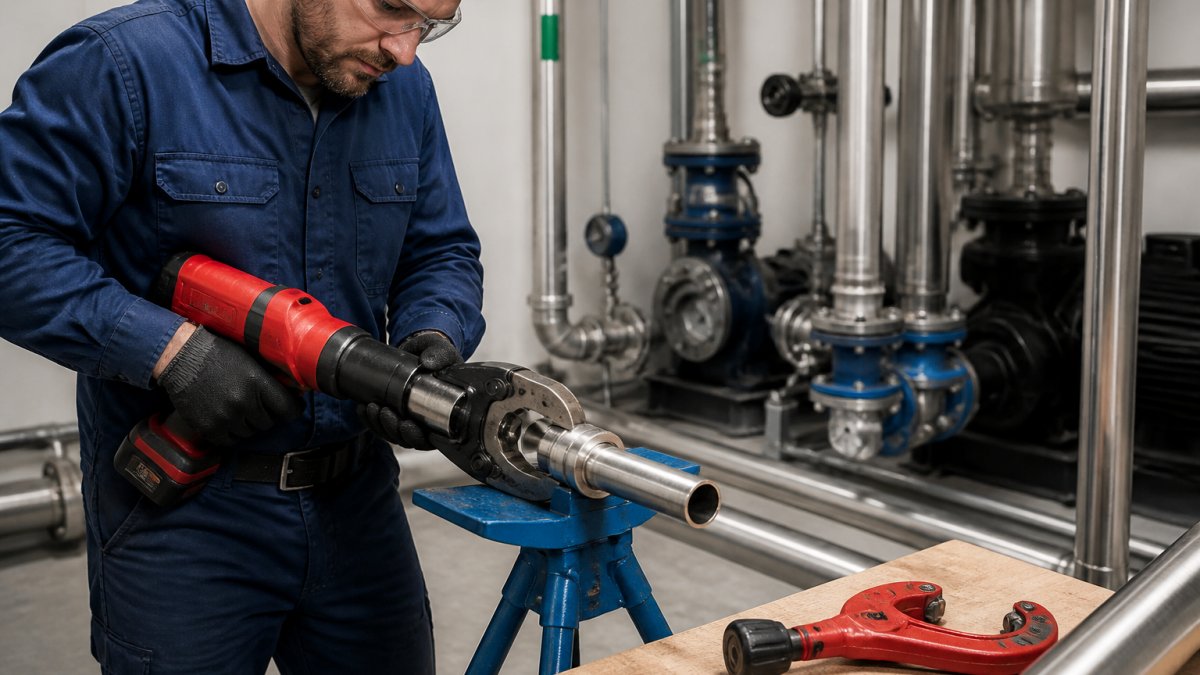
- Cut square with a suitable pipe cutter and check the end is true.
- Deburr and clean the pipe end, removing swarf and contamination.
- Mark insertion depth so you can confirm full engagement.
- Insert fully to the marked depth, without twisting or forcing.
- Check the press tool is calibrated, correct profile and correct jaw size.
- Press in one continuous action and confirm the tool completes its cycle.
- Pressure test the system before concealment or handover.
The tool matters as much as the fitting. An out-of-calibration press tool, or one fitted with the wrong jaw, will produce joints that pass a visual check and fail a pressure test.
Press-Fit Plumbing Maintenance and Inspection
Press-fit systems need less routine maintenance than soldered joints, but "less" is not "none". Inspection should focus on the joints you can see and the conditions affecting the ones you cannot.
A practical inspection routine:
- Visual check of accessible joints for weeping, staining or corrosion at each service interval
- Pressure testing after any modification to the system
- Support check to confirm brackets and clips are intact
For concealed pipework, the strategy shifts to prevention: get the installation right first time, pressure test before closing in, and keep records. Repair time on a concealed failed joint is far higher than on an accessible one, so installation quality outweighs any maintenance schedule.
Concealed Pipework: Managing Risk Where You Can't See the Joint
Concealed pipework is where press-fit systems earn or lose their reputation. A joint behind a wall or above a ceiling cannot be watched, so risk must be managed before it is covered.
The approach that works:
- Pressure test before concealment, every time, with the result recorded
- Use certified systems with documented compliance, such as WaterMark certification where it applies to the product
- Keep installation records including tool, operator and date
WaterMark certification applies to products within its scope; it is not a blanket requirement for every plumbing product or application (What is WaterMark?). Where certification applies, confirm the specific model against the current certificate schedule rather than assuming a range is covered.
Pros and Cons of Press-Fit Plumbing
Press-fit plumbing is fast, repeatable and flame-free, but it is not the right answer for every job.
Pros:
- Fast installation compared with soldering, which reduces labour time
- No hot works, which suits confined spaces and occupied buildings
- Consistent joints when the tool and procedure are controlled
Cons:
- Requires investment in the correct press tool and jaws
- Demands discipline: preparation and tool calibration are not optional
- Less forgiving of poor technique than some traditional methods
| Factor | Press-Fit | Push-Fit | Soldered |
|---|---|---|---|
| Joint type | Permanent crimp | Push-on, often demountable | Permanent, heat-fused |
| Hot works required | No | No | Yes |
| Tool investment | Press tool and jaws | None | Torch and consumables |
| Best for | Permanent and concealed runs | Repairs and accessible work | Traditional copper work |
| Key risk | Tool or preparation error | O-ring or insertion failure | Heat damage and flux residue |
For contractors weighing the tool investment, the decision usually comes down to job mix. High-volume commercial work with repeatable joints tends to justify the tool quickly, while smaller operations doing mostly accessible residential repairs may find push-fit or traditional methods more economical. Valtech Australia publishes its 316L stainless steel press-fit range, including pipe and fittings, for contractors and merchants comparing options.

Conclusion
The honest answer to whether press fit plumbing is safe long-term is that it depends on the system and the installation, not the category.
Valtech Australia supplies WaterMark certified 316L stainless steel press-fit pipe and fittings under certificate WM 75254, using the M press profile, with a 25-year product warranty subject to the warranty terms, correct installation and appropriate application.

Frequently Asked Questions
How long will press-fit fittings last?
There is no single figure that applies to every press-fit plumbing system. Service life depends on the fitting material, the quality of the press, water chemistry, operating pressure and temperature, and whether the joint was prepared and pressed correctly. Rather than relying on a generic number, check the manufacturer's stated warranty and application limits for the specific system you are specifying. Valtech Australia backs its 316L stainless steel press-fit range with a 25-year product warranty, subject to the warranty terms, correct installation and appropriate application.
Are press-fit plumbing fittings reliable?
A correctly pressed joint on a compliant fitting is a mechanical, permanent connection, and press-fit plumbing is widely used in commercial and residential work. Reliability comes down to three things: using WaterMark certified product for the application, matching the press tool and jaw to the fitting profile, and pressing every joint fully. Skipping any of these is where reliability drops. Valtech's system uses the M press profile and is WaterMark certified under WM 75254, with documentation supplied so specifiers can confirm the applicable model in the current certificate schedule.
What can cause a press-fit plumbing connection to fail?
The common causes are practical rather than mysterious: an unpressed or partially pressed joint, a pipe not inserted to the correct depth, a scratched or contaminated sealing surface, the wrong jaw or tool for the fitting profile, and excessive stress on the joint from poor pipe alignment. Water quality is a separate factor, since aggressive water chemistry can affect some materials over time. Where chlorine, chloride or unusual water conditions are a concern, have the application conditions assessed and follow the manufacturer's technical requirements rather than assuming any material suits every supply.
Can press-fit fittings be used for permanent plumbing?
Yes. Metal press-fit systems are designed as permanent connections, not temporary repairs, and are commonly specified for concealed and long-life installations. That said, permanent does not mean fit-and-forget regardless of conditions. Confirm the product is certified for the application, install it to the manufacturer's requirements, pressure test the system before closing in, and keep records of the installation. For 316L stainless steel press-fit, check the WaterMark certificate schedule and Valtech's technical requirements for the specific size and application.