

Benefits of Press-Fit Over Welding for Stainless Pipe
Table of Contents
- Press-Fit vs Welding: How the Two Joining Methods Compare
- Press-Fit vs Welding Installation Time on Site
- Stainless Steel Press Fittings vs Welded Fittings: Joint Strength and Reliability
- Hot Work, Fire Risk and Worker Safety
- Labour Costs, Tooling and Setup Time
- Press-Fit Connection Inspection and Quality Assurance
- Press-Fit Fittings Disadvantages and When Welding Still Wins
- Lifecycle Cost, Repairability and Choosing the Right System
- Frequently Asked Questions
Last Updated: October 14, 2026
Press-Fit vs Welding: How the Two Joining Methods Compare
The benefits of press-fit over welding start with a simple difference: one method joins stainless steel pipe with a mechanical crimp, the other with heat and filler metal. Press-fit uses a tool to compress a fitting onto the pipe, cold-forming a permanent connection.
At Valtech Australia, the 316L stainless steel press-fit range is built around the M press profile and is WaterMark certified under WM 75254.

How a Press-Fit Joint Is Made
A press-fit joint forms when a fitting containing an O-ring is slid onto a prepared pipe end and compressed with a press tool and the correct press jaws. The tool drives the jaws closed, deforming the metal to grip the pipe and compress the O-ring, producing a mechanical, heat-free connection. Pipe preparation is limited to a clean, square cut and deburr.
How a Welded Joint Is Made
A welded joint is created by heating the pipe and fitting until the parent metal and a filler rod fuse together. The joint is typically tacked, then fully welded around the circumference, and often purged with shielding gas to protect the internal weld from oxidation. The weld usually then needs cleaning and, in many cases, inspection or testing before the line is closed up.
Press-Fit vs Welding Installation Time on Site
Press-fit is faster than welding on almost every commercial job because it removes the two biggest time sinks: heat and post-weld finishing. A press connection is made in a single tool cycle, while a welded joint involves tacking, full welding, cooling and often cleaning or inspection before sign-off.
That gap compounds across a project. Where a line has dozens or hundreds of joints, the difference in installation speed translates directly into labour hours saved and a shorter programme.
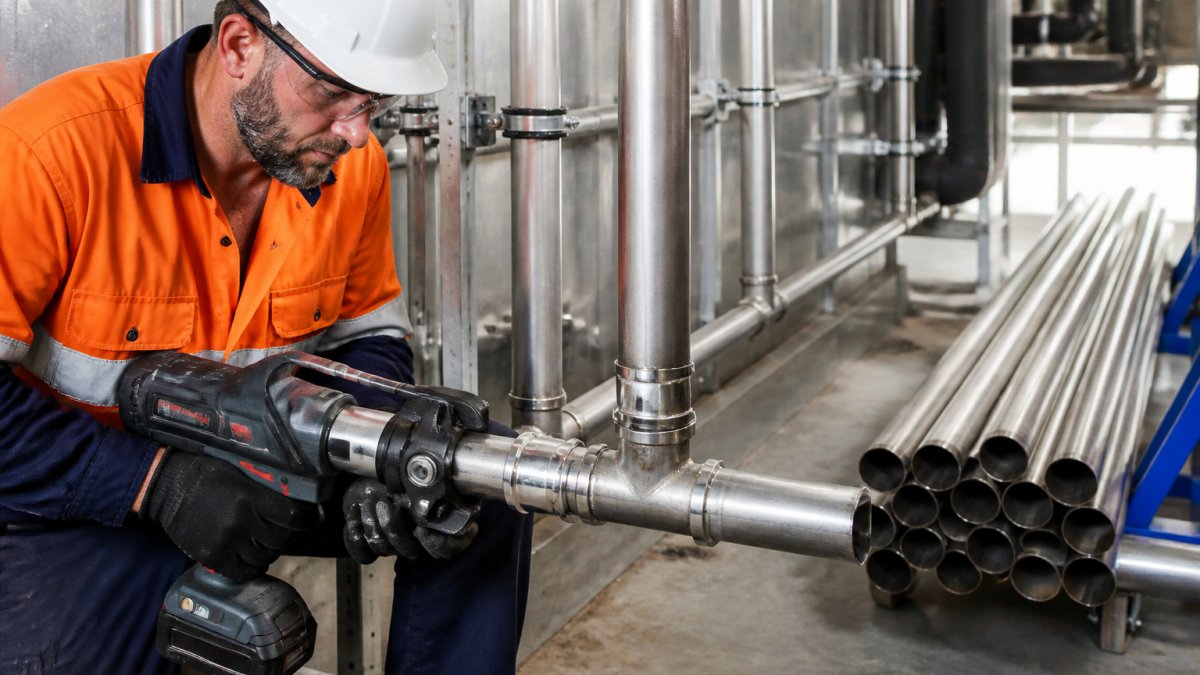
Stainless Steel Press Fittings vs Welded Fittings: Joint Strength and Reliability
Both methods produce strong, reliable joints when installed correctly, but they fail in different ways. A properly made weld is a continuous metallurgical bond; a properly made press joint is a mechanical connection relying on the fitting, the O-ring and a correctly calibrated tool.
The practical difference is consistency. Weld quality depends heavily on the individual welder's skill, technique and conditions, and varies from joint to joint.
Hot Work, Fire Risk and Worker Safety
Removing the flame is the safety benefit that changes how a job is planned. Welding introduces fire hazards, sparks and molten slag, and usually triggers a hot-work permit and a fire watch.
That matters in confined spaces, occupied buildings and areas with combustible materials nearby. Crews can work without the shutdowns and supervision a hot-work permit demands, and fewer exposed hazards means less risk to the people doing the work.
Labour Costs, Tooling and Setup Time
Press-fit shifts cost from labour hours to tooling. A press tool and the correct press jaws are a capital outlay, but once on site they cut the time and skill required per joint.
Setup time tells a similar story. A press tool is ready as soon as it is charged and the right jaws are fitted, while welding requires gas, consumables, purging and a safe hot-work area before the first joint.
| Factor | Press-Fit | Welding |
|---|---|---|
| Heat source | None | Flame or arc |
| Hot-work permit | Not required | Usually required |
| Skill dependency | Tool and fitting driven | Welder skill driven |
| Post-joint finishing | Minimal | Cleaning and inspection |
| Site disruption | Low | Higher |
Press-Fit Connection Inspection and Quality Assurance
Quality assurance is where press-fit either earns its reliability reputation or loses it. The method is repeatable, but only when the tool, the jaws, the installer and the inspection routine are all controlled. The practical detail matters more than the claim.
Joint Preparation Checks
Before the fitting goes on, confirm the pipe end is cut square, deburred and free of score marks, swarf or moisture. A burr can damage the O-ring as the fitting slides on, and a damp or dirty pipe end can compromise the seal. Mark the insertion depth with a depth gauge or marker so the fitting seats fully every time, a part-way fitting may press without leaking immediately but will not perform as designed.
Tool and Jaw Selection
Press tools are matched to specific jaw sets and fitting profiles. Using the wrong jaw for the fitting size or profile will produce an incomplete press that may pass a visual check and fail later. Confirm the tool is rated for the pipe diameter, the jaws match the fittings in use, and the tool's calibration is current.
Visual Verification
Most press systems are designed so an unpressed joint is visible. Fittings often carry a witness mark, coloured indicator or profile change that disappears once the jaws have closed. Train crews to check every joint against that indicator before the line is closed up or insulated. The most common press-fit failure mode is a joint fitted but never pressed, and the easiest to prevent with a consistent visual check.
316L Stainless Steel Equal Coupling 15 →
Press-and-Mark Routine
A simple workflow change eliminates most missed presses. After each joint is pressed, mark it immediately with a paint pen or marker. The mark confirms the joint has been through the tool and signals to the next trade that the connection is complete. On large jobs with multiple crews, it also makes handover and partial completion visible without re-checking every joint.
Leak Testing
Press-fit does not remove the need for pressure testing. The system should be tested in line with the project specification and relevant plumbing requirements before commissioning. Test pressures, durations and acceptable leakage criteria are set by the specification and applicable standards, not the joining method. Where the specification calls for it, isolate sections so a failure can be traced to a specific run.
Documentation and Traceability
For commercial projects, keep a record of tool calibration, installer training and test results. Hydraulic consultants and certifying authorities may ask for this during inspection. Valtech Australia's 316L stainless steel press-fit range is WaterMark certified under WM 75254, and documentation can be supplied to support the compliance file. The 25-year product warranty is subject to the warranty terms, correct installation and appropriate application, so installation records matter if a claim is ever needed.

Press-Fit Fittings Disadvantages and When Welding Still Wins
Press-fit is not the right answer for every application. The main limitations sit around tooling, training and application suitability, and welding still wins in specific cases.
- Tooling investment: A press tool and jaws are an upfront cost, which can be hard to justify for a very small operation.
- Training dependency: Crews need to learn the system, and a missed press is the key risk.
- Application limits: Where water chemistry, chlorine or chloride exposure is aggressive, suitability must be assessed before specifying stainless steel.
For most commercial plumbing and mechanical services work, though, press-fit covers the majority of joints. Valtech Australia's 316L stainless steel press-fit range, including equal couplings and pipe, is designed for these applications, with WaterMark documentation supplied and a 25-year product warranty subject to the warranty terms, correct installation and appropriate application.
Lifecycle Cost, Repairability and Choosing the Right System
Lifecycle cost is where the press-fit argument usually settles, but most comparisons stop at installation labour and never reach the numbers that matter over a 20- or 30-year asset life. A more useful frame is the full cost stack: tool investment, consumables, inspection, maintenance, downtime and repair.
The Cost Stack Compared
| Cost Category | Press-Fit | Welding |
|---|---|---|
| Tool investment | Press tool and jaw sets, upfront capital | Welding plant, gas, PPE, fume extraction |
| Consumables | O-rings (factory-fitted), occasional jaw service | Filler rods, shielding gas, grinding and cleaning consumables |
| Labour skill | Trained installer, tool-driven consistency | Certified welder, skill-dependent quality |
| Inspection | Visual joint-by-joint, sample pressure testing | Often non-destructive testing on a sample basis |
| Hot-work controls | Not required | Permit, fire watch, standby time |
| Rework rate | Low when tool and routine are controlled | Variable, tied to welder skill and conditions |
| Downtime for repair | Cut out and re-press, no hot work | Re-weld, permit, shutdown, cool-down |
Tool investment is the obvious upfront difference, but it is a one-off cost spread across every joint on every project the tool serves. Consumables are lower and more predictable with press-fit because the seal is factory-fitted and the joint needs no gas, filler or post-weld cleaning. Inspection cost is lower because the check is visual and joint-by-joint rather than sample-based and destructive.
Repairability in Practice
A press joint that is damaged or leaking is typically cut out and replaced with a coupling or short spool. The repair is mechanical, needs no hot-work permit, and can usually be done in a live plant room without isolating the whole system. A welded repair brings the flame, permit, fire watch and often a shutdown window back into the equation.
Where Welding Still Wins on Lifecycle
Welding remains the right choice where the specification requires a fully welded, continuous metallic joint, or where very high-temperature service rules out an elastomeric seal. In those cases press-fit is not an option. Selection should follow the application, not the other way around.
Decision Criteria
Work through these before specifying:
- Fluid and water chemistry: Aggressive water chemistry, chlorine or chloride exposure can affect stainless steel suitability. Application conditions should be assessed and Valtech's technical requirements followed before specifying.
- Operating temperature: Where service temperature is high enough to rule out an elastomeric seal, welding is the appropriate method.
- Pressure and diameter: Confirm the system specification covers the pressure and diameter being installed. Do not assume a method is suitable without checking the specification.
Where Valtech Australia Fits
Valtech Australia supplies premium 316L stainless steel press-fit pipe and fittings using the M press profile, WaterMark certified under WM 75254, with a 25-year product warranty subject to the warranty terms, correct installation and appropriate application. Plumbers and contractors can access trade pricing through Trade Pricing for Plumbers & Contractors, and Valtech Australia can provide commercial plumbing project quotations for larger jobs.
Frequently Asked Questions
Is press-fit pipe installation faster than welding?
For most stainless steel pipework, yes. A press-fit joint is made by inserting the pipe into a fitting that carries an O-ring, then closing the press jaws with a press tool. There is no flame, no filler metal and no cooling time, so a connection is completed in seconds. Welding adds preparation, tacking, full welds, cooling and often a hot-work permit before anyone can start. Exact time savings depend on pipe diameter, access and how many joints a crew completes in a shift, but the sequence itself is shorter at every step.
Do press-fit connections require hot work?
No. Press-fit is a heat-free joining method. There is no open flame, no sparks and no molten slag, so a press-fit connection does not need a hot-work permit the way welding or brazing does. That matters on occupied sites such as shopping centres, hospitals and food processing plants, where hot-work restrictions can delay or stop welded pipework. Always confirm site-specific requirements with the relevant authority and the project's fire safety plan before starting work.
How do you check a press-fit connection has been installed correctly?
Inspection relies on the tool and the fitting, not on a visual weld bead. Most press tools record each cycle and flag incomplete or missed presses, and many fittings carry a witness mark or indicator that shows the jaws have closed fully. Check that the pipe is inserted to the marked depth, that the correct press jaw and profile were used, and that the O-ring was not damaged or displaced before pressing. Record the tool data and mark each completed joint so a missed press is easy to spot.
What are the disadvantages of press-fit fittings?
Press-fit needs a compatible press tool and the correct jaws for each size, which is an upfront investment. The O-ring is the sealing element, so installation must follow the manufacturer's requirements for insertion depth, jaw selection and pressing, and damaged or displaced O-rings cause leaks. Application conditions matter too: water chemistry, chlorine and chloride exposure, temperature and environment all affect suitability, so those should be assessed against the manufacturer's technical requirements. Welding also remains the better choice in some high-temperature or specific industrial applications.
Choosing a joining method is really a decision about labour, risk and programme, not just fittings. Valtech Australia supplies WaterMark certified 316L stainless steel press-fit pipe and fittings using the M press profile, backed by a 25-year product warranty subject to the warranty terms, correct installation and appropriate application, along with trade pricing and commercial project quotations. Get started with Valtech Australia and specify a press-fit system built for commercial work.