

Benefits of 316L Stainless Press-Fit Piping
Table of Contents
- What Makes 316L Stainless Press-Fit Systems Different
- Superior Corrosion Resistance in Demanding Environments
- 316 vs 316L Stainless Steel: Why the Difference Matters
- Installation Speed and Labour Efficiency
- Understanding Stagnant Water Corrosion in Stainless Steel Pipes
- Limitations of 316 Stainless Steel and When to Upgrade
- Long-Term Cost and System Reliability
- Conclusion
- Frequently Asked Questions
Last Updated: October 5, 2026
What Makes 316L Stainless Press-Fit Systems Different
The 316L stainless press-fit system uses hydraulic force to create permanent, leak-proof connections in seconds, unlike soldering, threading or mechanical compression. Valtech Australia's 316L stainless steel press-fit range, certified under WaterMark WM 75254 with the M press profile, delivers that assembly speed while maintaining the material integrity harsh environments require.

The advantage is simplicity: a trained operator positions the fitting onto the pipe, activates the press tool, and the connection is complete, no open flames, threading compounds or waiting for solder to cool.
Superior Corrosion Resistance in Demanding Environments
Stainless steel's durability rests on a passive oxide layer that forms when exposed to oxygen. Not all stainless steel performs equally in all environments.
316L stainless steel includes molybdenum and has lower carbon content than 304, providing better resistance to chloride attack, critical in coastal areas, regions with high-chlorine water treatment, and facilities with harsh chemical exposure.

Valtech Australia's 316L stainless steel press-fit range is designed for corrosive conditions across Australia.
The passive oxide layer requires oxygen to maintain itself. In properly designed and maintained systems this renewal is continuous, but stagnant water or low-flow conditions can compromise it.
316 vs 316L Stainless Steel: Why the Difference Matters
Most specifiers asking about 316L are really choosing between 304 and 316L; the 316-versus-316L distinction is secondary.
The three grades, side by side
| Property | 304 | 316 | 316L |
|---|---|---|---|
| Molybdenum | No | Yes | Yes |
| Typical carbon content | Up to 0.08% | Up to 0.08% | 0.03% or lower |
| Relative chloride/pitting resistance | Lower | Higher | Higher, with lower sensitisation risk |
| Typical use | General inland potable water | Coastal | Coastal and long-life applications |
304 is the workhorse grade for general plumbing and HVAC where water chemistry is benign. 316 adds molybdenum, improving resistance to pitting and crevice corrosion in chloride-bearing conditions. 316L is the low-carbon variant of 316: carbon is capped at 0.03% or lower, reducing the risk of chromium carbide precipitation (sensitisation) at grain boundaries during welding or high-temperature exposure.
Why the "L" matters more than most people think
When carbon combines with chromium at grain boundaries, the surrounding metal is left chromium-depleted and less able to form its passive oxide layer, creating an initiation point for intergranular corrosion. In welded 316 assemblies this is why post-weld heat treatment or a stabilised filler is often specified.
For press-fit systems, no welding occurs during installation, so the sensitisation argument is less direct.
When 316L is worth it over 304
The honest answer is: not always. 304 press-fit performs well in many inland commercial and residential potable-water installations where municipal water chemistry is within normal ranges and pipework is not exposed to aggressive external conditions. Specifying 316L everywhere adds cost without corresponding benefit.
316L earns its place when one or more of the following apply:
- Coastal or marine exposure. Salt spray and airborne chlorides accelerate pitting in 304. Within the coastal influence zone, 316L is the more defensible choice.
- Elevated or variable chloride in the water.
- Chemical or process exposure.
- Long design life with low maintenance tolerance. Where pipework is buried, concealed, or access for replacement is difficult, 316L's additional corrosion margin is cheap insurance against a very expensive failure.
When 304 is the sensible choice
For inland commercial fitouts, standard potable-water reticulation and HVAC applications where water chemistry is known and benign, 304 press-fit is a legitimate specification. Choosing 316L here is a cost decision, not a technical necessity.
The decision rule
A practical rule used by many hydraulic consultants: start with 304, upgrade to 316L when the environment or water chemistry pushes you out of the benign envelope, or when design life and access constraints make failure unacceptable. The upgrade is about matching the material to actual conditions, not abstract "better".
Application conditions should always be assessed before specifying any stainless grade. Where chloride, chlorine or water quality may affect suitability, follow the manufacturer's technical requirements and, for Valtech Australia's 316L stainless steel press-fit range, confirm the application against Valtech's published technical guidance.

Installation Speed and Labour Efficiency
Press-fit assembly eliminates the time-intensive steps of soldering and threading.
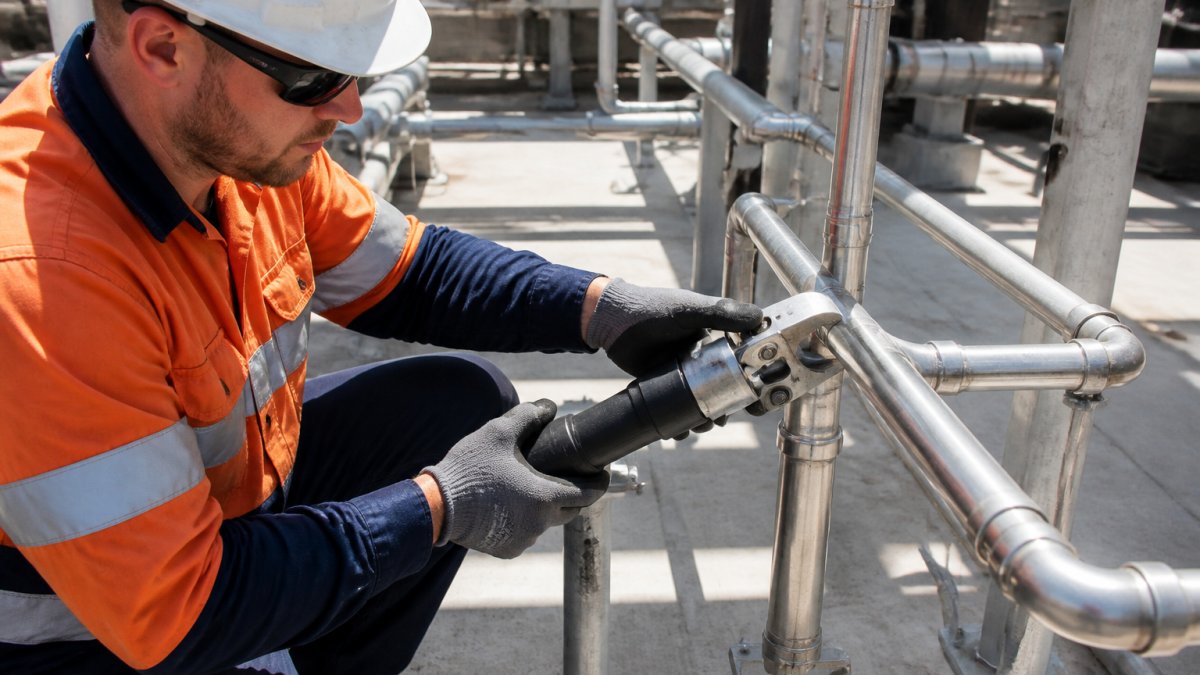
On large projects the labour savings accumulate rapidly: a commercial building with hundreds of connection points sees installation time reduced by hours per day, translating to faster completion and reduced on-site labour costs. For contractors managing multiple commercial plumbing projects, the efficiency gain is material, and for those seeking to optimise project delivery, trade pricing for plumbers and contractors on Valtech Australia's 316L stainless steel press-fit range can improve project margins.
Press-fit systems also eliminate hot works permits in confined spaces. Soldering requires an open flame and generates heat, triggering strict safety protocols in shopping centres, hospitals and other occupied facilities.
Valtech Australia's M press profile is compatible with standard hydraulic press tools available across the Australian plumbing trade. Contractors do not need proprietary equipment or retraining on unfamiliar assembly logic.
Understanding Stagnant Water Corrosion in Stainless Steel Pipes
One of the most misunderstood failure modes in stainless steel piping is corrosion in low-flow or stagnant water conditions.
Stainless steel's corrosion resistance depends on continuous renewal of the passive oxide layer through dissolved oxygen.
This is why dead legs (sections of pipe with no flow) and low-velocity zones are problematic.
Application conditions should be assessed carefully before specifying any stainless steel system, including Valtech Australia's 316L stainless steel press-fit range.
Limitations of 316 Stainless Steel and When to Upgrade
While 316 stainless steel suits many applications, it has defined limits that make 316L the better choice in specific contexts.
Coastal and salt-spray environments: 316 stainless steel corrodes faster than 316L in areas with regular salt spray or high atmospheric chloride concentrations.
316L Stainless Steel Pipe 15 x 1.0 x 5800 →
High-chlorine water systems:
**
Extended service life requirements: If the installation is designed for 25+ years with minimal maintenance, 316L's lower sensitisation risk and superior chloride resistance justify the material cost.
Welded systems:
Valtech Australia's 316L stainless steel press-fit range is specified for environments where these concerns apply. For straightforward commercial or residential applications in non-coastal areas with standard municipal water, 316 may be adequate, but 316L provides insurance against future corrosion problems.
Long-Term Cost and System Reliability
Lifecycle cost in press-fit stainless systems is driven by four things: installation labour, maintenance and downtime, expected service life, and the cost of failure.
Installation labour
Press-fit assembly removes several time-consuming steps soldering and threading require: surface preparation, fluxing, heating, solder application and cooling for soldered joints; cutting, threading, sealant application and torque verification for threaded joints.
On a commercial project with hundreds of connection points the aggregate time difference is significant, but the exact saving depends on pipe diameter, access, tool availability and crew experience.
Two secondary labour effects are often overlooked:
- Hot works permits. Soldering in occupied buildings, shopping centres, hospitals and other sensitive facilities triggers permit and fire-watch requirements. Press-fit operates at ambient temperature, removing that administrative and supervisory overhead.
- Rework and inspection. A correctly made press connection is visually verifiable (the tool typically marks the joint). This can reduce the time spent on leak testing and rework compared with methods where joint quality is less immediately apparent.
Maintenance, downtime and the cost of failure
Carbon steel piping in coastal environments corrodes within a relatively short horizon, leading to discolouration, reduced flow and eventual failure.
Stainless systems, properly designed and installed, are intended to operate with minimal maintenance for decades. Valtech Australia's 316L stainless steel press-fit pipe and fittings are backed by a 25-year product warranty, subject to the warranty terms, correct installation and appropriate application.
Service life and reliability
Press-fit connections, once correctly made, are mechanically locked and do not rely on a sealant or threaded interface that can loosen under vibration or thermal cycling.
However, reliability is conditional. It depends on:
- Correct press profile, the tool must match the fitting system. Valtech Australia's system uses the M press profile.
- Tool maintenance and calibration, a poorly maintained tool can produce a joint that looks complete.
The compliance and approvals dimension
Lifecycle cost is only meaningful if the system is approved for the application. In Australia, plumbing and drainage products intended for use in regulated plumbing installations are generally subject to WaterMark certification, and requirements depend on the product type and intended use (What is WaterMark?).
Valtech Australia's 316L stainless steel press-fit range is WaterMark certified under WM 75254 with the M press profile. For a specifier, the practical checklist is:
- Confirm the product carries the certification required for its intended application.
Where any of these cannot be confirmed from published documentation, seek written confirmation from the supplier before specifying.
Putting it together
A lifecycle comparison looking only at material cost per metre will almost always favour carbon steel. One that includes installation labour, hot works management, maintenance access, downtime in occupied buildings and the probability of premature failure in the actual service environment will often favour stainless, but the outcome depends on the project. The honest position: 316L press-fit is a strong lifecycle choice in demanding environments and a defensible but not automatic choice in benign ones.
Conclusion
The benefits of 316L stainless press-fit piping extend across material durability, installation efficiency, and long-term system reliability.
Valtech Australia's 316L stainless steel press-fit range, certified under WaterMark WM 75254 with the M press profile, delivers these benefits in coastal systems. Plumbers, contractors and specifiers can rely on the material's durability and the system's ease of assembly to meet project timelines and performance requirements.
For projects in coastal areas or installations designed for extended service life, 316L stainless press-fit is the material of choice. Explore Valtech Australia's full range of 316L stainless steel pipe and fittings, including 316L Stainless Steel Pipe 15 x 1.0 x 5800, 316L Stainless Steel Equal Coupling 15, and 316L Stainless Steel 90° Equal Elbow 15. For commercial plumbing project quotations or to discuss your specific application requirements, contact Valtech Australia directly, or register for trade pricing for plumbers and contractors to access competitive rates for your next project.
Frequently Asked Questions
What are the main benefits of 316L stainless press-fit systems for plumbing?
316L stainless press-fit systems offer corrosion resistance in harsh environments, fast welding-free installation, leak-proof connections, and long service life. The press-fit method eliminates hot works, reduces installation time, and removes the need for threading or soldering. Valtech Australia's WaterMark certified 316L press-fit range (WM 75254) is designed for commercial plumbing applications where reliability and durability matter.
Which is better, 316 or 316L stainless steel?
316L contains lower carbon content than 316, making it more resistant to intergranular corrosion after welding. For press-fit applications where the material is not welded, both perform well in most environments. However, 316L is superior in high-chloride or coastal settings. The choice depends on water chemistry and application conditions, assess your specific environment and follow Valtech's technical requirements.
Can stagnant water cause corrosion in stainless steel pipes?
Yes. Stagnant water with low oxygen and high chloride or mineral content can cause localised corrosion (pitting) even in stainless steel. This is why proper system design, regular flushing, and material selection matter. In high-risk environments, 316L offers better protection than 304 or 316. Always assess water chemistry and consult technical guidance before selecting materials for static or low-flow applications.
How does stainless steel press-fit installation differ from traditional methods?
Press-fit connections use a mechanical press tool to join pipe and fittings without heat, welding, or threading. This eliminates hot works permits, reduces installation time, and removes skill dependency on soldering or threading expertise. The M Profile system used by Valtech Australia creates leak-proof, vibration-resistant connections. No special chemicals or flux are needed, making it faster and safer on confined-space or restricted-works sites.
Stainless steel piping systems require careful application assessment. Consult Valtech Australia's technical documentation and installation guidelines to ensure your project meets WaterMark certification requirements and delivers the performance your application demands.